
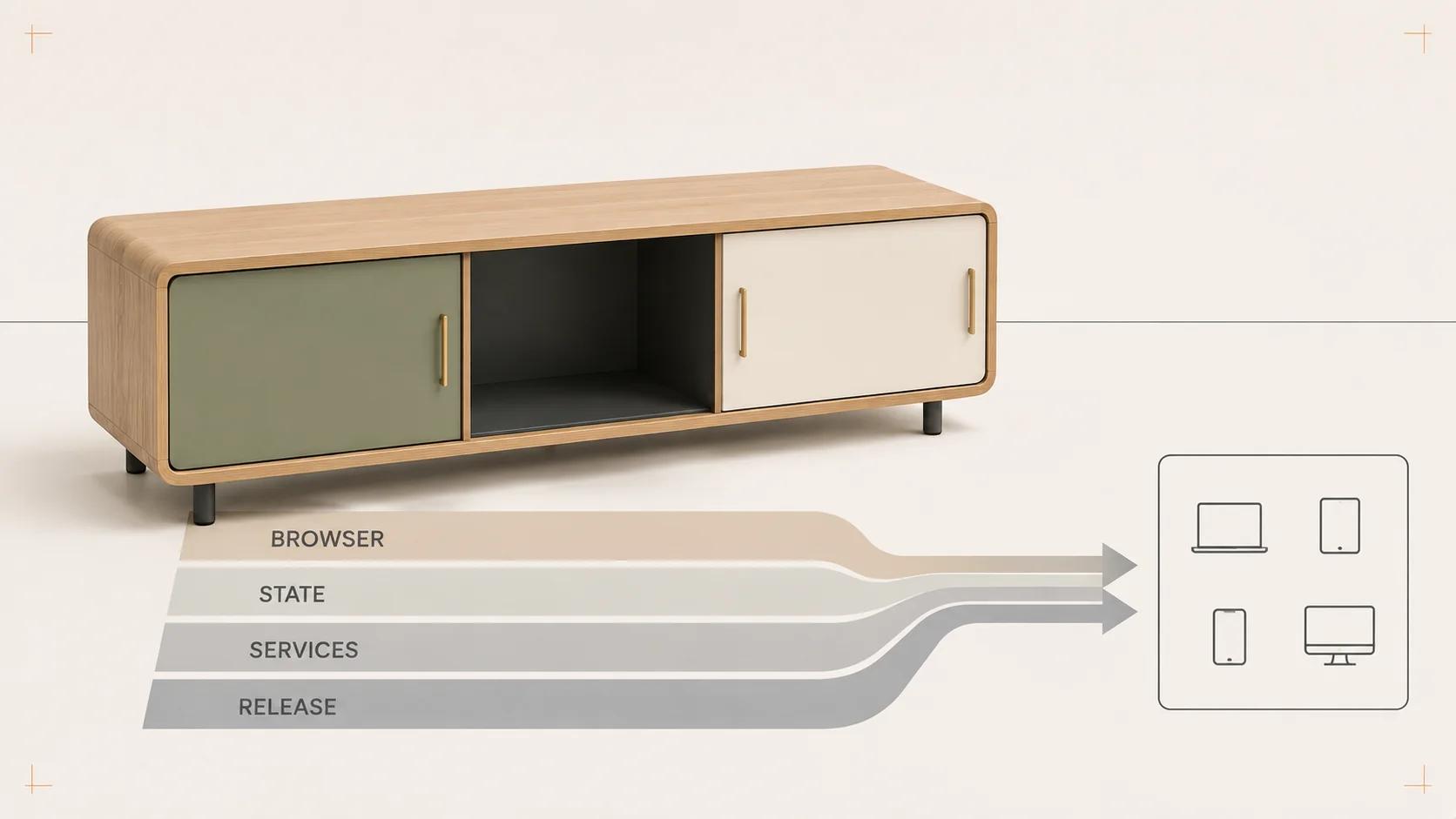
A sound 3D web configurator architecture gives each concern one clear owner. The browser handles interaction, immediate visual feedback and recoverable working state. Product services decide which combinations are valid. Commerce systems remain authoritative for price, availability and transactions. Versioned asset delivery connects the resolved product to the 3D scene, while a release manifest records which application, rule and asset versions belong together.
That separation matters more than the choice of rendering library. If controls, 3D node names, pricing calls and cart payloads each carry their own version of product truth, they will eventually disagree. The safer design moves a proposed selection through an explicit resolution contract, then lets the interface and renderer consume the same result.
This guide covers the full-stack architecture: where browser code and backend authority meet, how state crosses that boundary, and how releases are deployed and rolled back. For client-side rendering behavior and interaction performance, use the real-time 3D configurator guide. For monitoring, incident response and routine work after launch, use the custom configurator maintenance guide. The e-commerce integration blueprint follows the broader journey through product data, cart, order and analytics.
Treat the configurator as six contracts
A useful reference architecture has six contracts rather than one large "configurator" box. The boundaries can live in one codebase or several services. What matters is that each has a named responsibility, input, output and version.
| Contract | Owns | Must not silently own |
|---|---|---|
| Experience client | Controls, guidance, camera intent, visual feedback and recovery | Commercial validity, authoritative price or inventory |
| Configuration state | Stable selected IDs, market context, rule version and resolution result | UI labels as identifiers or unvalidated derived totals |
| Product rules | Defaults, dependencies, exclusions, calculations and valid transitions | Renderer node names, page layout or cart presentation |
| Asset delivery | Versioned models, textures, environment assets, fallbacks and visual mappings | Sellability, manufacturing approval or product compatibility |
| Domain and commerce APIs | Saved configurations, authorization, price, availability, quote, cart and order contracts | Reconstructing a configuration from screenshots or display copy |
| Release operations | Environment config, compatibility manifest, telemetry, rollout and rollback | Unreviewed changes to product rules or assets |
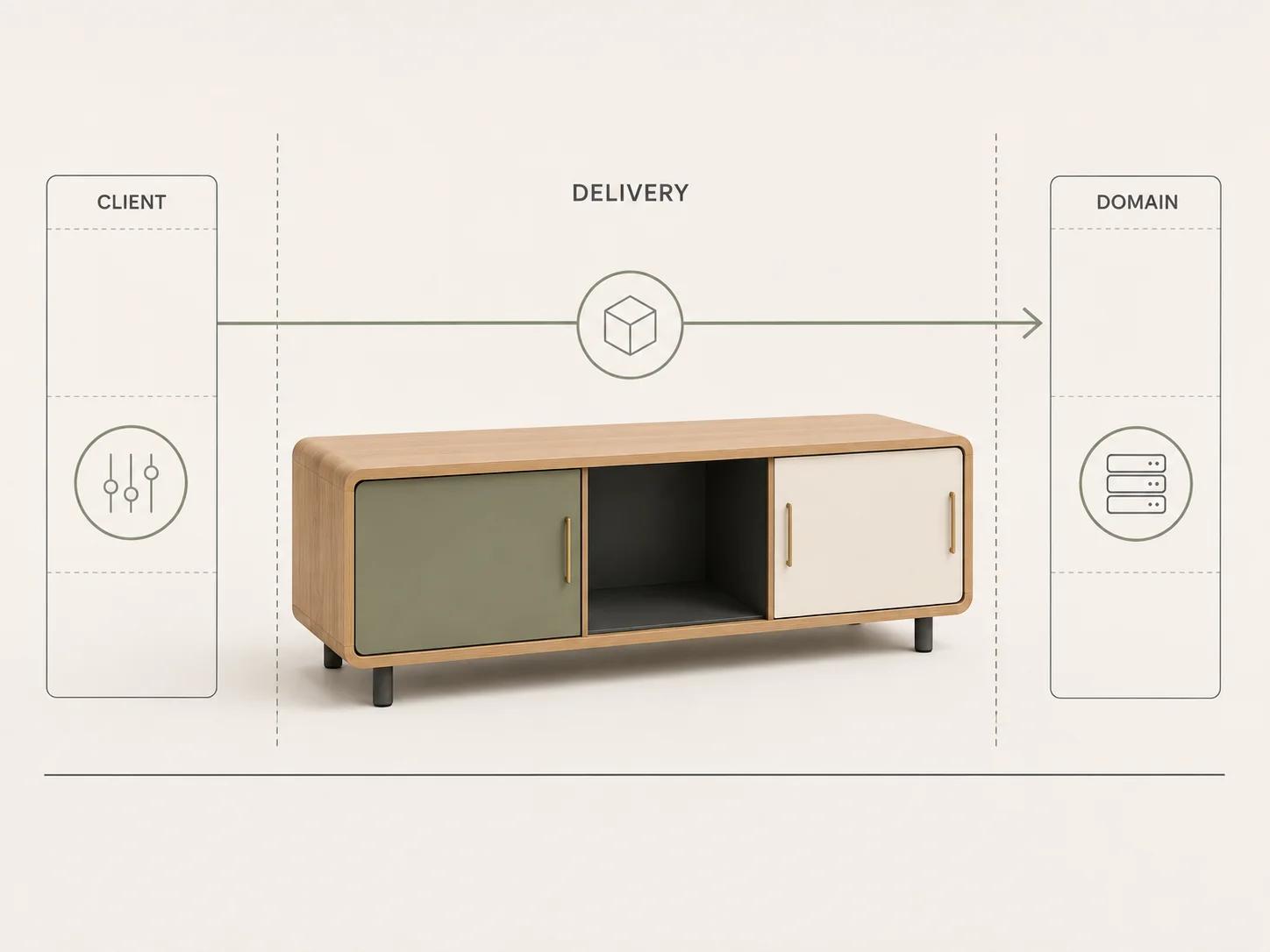
The browser can host several of these modules, but co-location does not erase ownership. A bundled rule evaluator may provide fast feedback, for example, while the transaction boundary still validates the submitted state against the approved server rule version. Likewise, a model can carry useful node and material metadata without becoming the catalog database.
Draw arrows for actual payloads, not vague system relationships. Name the candidate-state request, resolved-state response, asset manifest, price response, saved-configuration record and cart line. Then record timeout, stale-version and rejection behavior for every arrow. This exposes the difficult work that a polished viewer mockup tends to hide.
Keep the browser responsive without making it authoritative
The browser is the latency-sensitive edge of the system. It should preserve the current selection while a model loads, show why an option became unavailable, keep the camera stable through visual changes and recover from a failed request without dropping the user's work. It should not approve a commercial transaction merely because its local controls prevented an obvious invalid combination.
Keep input handling, semantic controls and lightweight state updates separate from expensive geometry or rule calculations. Web Workers can run scripts on a background thread so long tasks do not block the main UI thread; workers cannot directly manipulate the DOM and communicate with the main thread through messages.[3] That makes a worker a measured option for proven blocking work, not a default place to move the whole application. Define the message schema and cancellation behavior before adding one.
Render from resolved state rather than from click events. If a user selects a wide shelf and the rule result removes an incompatible door, one result should name the accepted option, removed option and reason. The controls explain the change, the 3D adapter updates the correct parts and analytics records the same typed transition. None of those consumers needs to reimplement the rule.
Use browser storage for recovery, not product authority
A longer configuration may merit local recovery when a tab closes or a network request fails. IndexedDB is an asynchronous browser API for storing significant amounts of structured data, including files and blobs.[4] It can hold a recoverable working draft, cached manifest or pending synchronization record without making that local copy commercially valid.
Store a schema version and expiry with any local draft. On reopen, resolve it against the current product and rule versions before presenting it as available to buy. A share link should normally point to a server-owned configuration ID or a deliberately bounded, signed payload. Do not place private pricing, personal data or an unrestricted manufacturing specification in a URL simply because URLs are easy to share.
Move state through candidate, resolved and committed forms
"State" is too broad unless the architecture names its stage. A candidate state is what the user is asking for. A resolved state is what the approved rule set accepts, including automatic changes and reasons. A committed state is what an authoritative downstream action accepted at a known version and price context.
JSON Schema defines a vocabulary for assertions about valid JSON structure, including required properties and dependencies between properties.[2] Use it to validate payload shape at boundaries. Keep engineered constraints, market policy and commercial calculations in an owned rule layer with executable examples; a structural schema does not replace those decisions.
| State form | Minimum useful contents | Acceptance question |
|---|---|---|
| Candidate | Product family, selected stable IDs, market and current rule version | Can the rule layer interpret this request without labels or scene names? |
| Resolved | Accepted IDs, removed or added IDs, reasons, derived values and rule version | Do controls, summary and 3D mapping consume this exact result? |
| Committed | Resolved snapshot, authoritative price response, owner, timestamps and downstream reference | Can the cart, quote or order be audited and reopened under its original versions? |
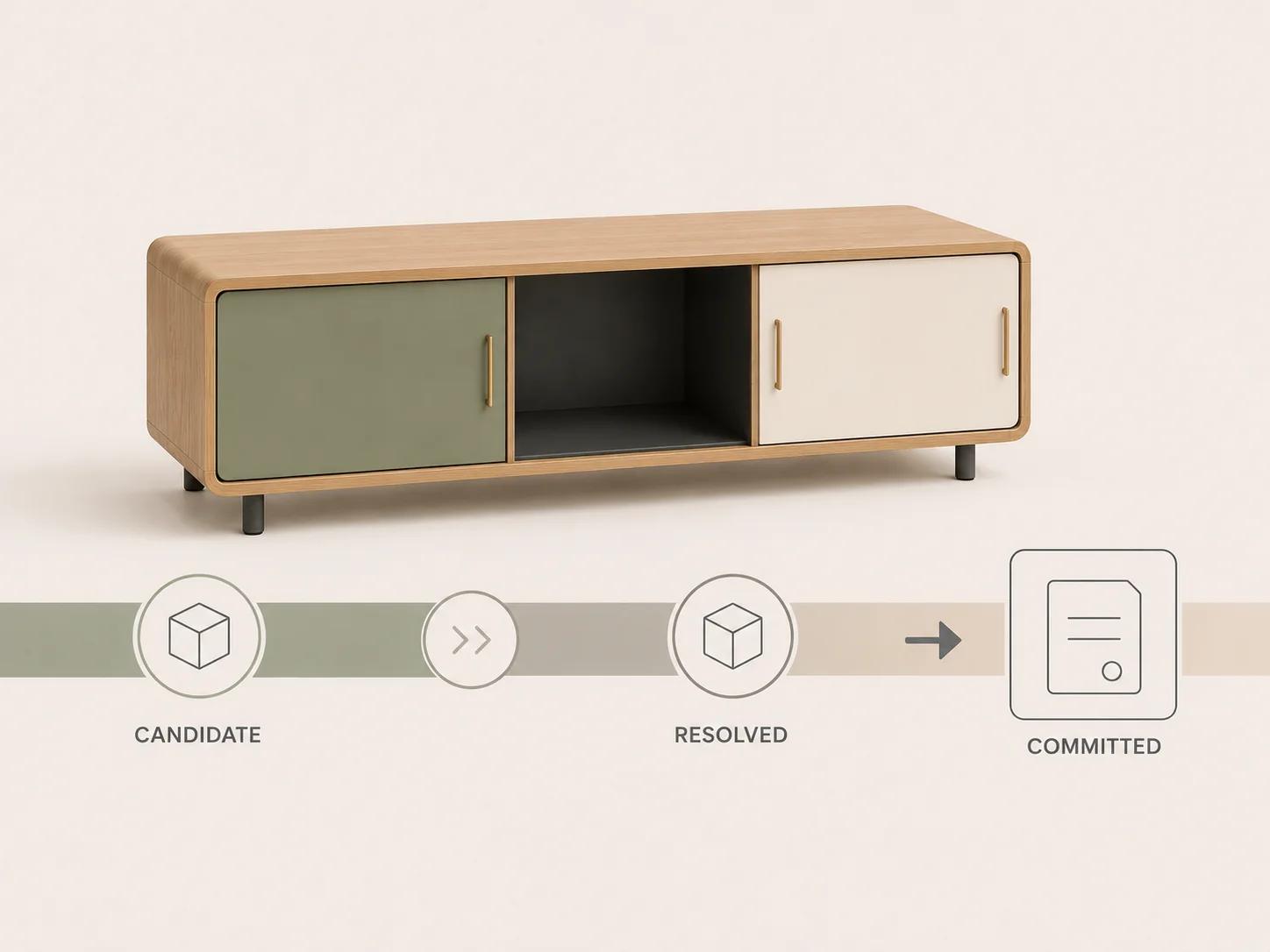
Stable identifiers are the spine. A finish can be renamed for a locale without changing its ID. A mesh can be rebuilt without changing the sellable option. Keep product IDs, rule IDs and asset mapping IDs distinct so a content update does not masquerade as a product-rule change.
Add an explicit concurrency decision for saved configurations. If the catalog changes between save and reopen, the system can reject the old state, migrate it through reviewed rules or preserve it for reference only. Silent reinterpretation is the dangerous option because the same saved ID can appear to mean two different products.
Deliver 3D assets as versioned presentation data
glTF is an API-neutral runtime asset delivery format. Its specification describes scenes, nodes, transforms, meshes, materials, cameras and animations, but does not mandate runtime behavior.[1] A GLB can therefore carry the visible product efficiently without deciding whether a combination may be sold, how it is priced or which SKU reaches the cart.
Put a visual mapping layer between resolved option IDs and scene details. That mapping can select an asset bundle, toggle a component, assign a material, set a transform or choose a camera cue. Validate the mapping during asset publishing so a missing node or material slot fails before release. In the runtime, report a controlled fallback rather than showing a partly configured product as if it were complete.
Use immutable URLs for published asset revisions and let a small manifest point to the active versions. MDN's Cache-Control guidance describes versioned or hashed resource URLs paired with long freshness and immutable; changing the resource produces a new URL instead of mutating cached content in place.[7] Apply a different policy to the HTML shell or release manifest when clients must revalidate and discover a new build.
Choose packaging after measuring the product. One GLB may simplify atomic delivery. Separate geometry and texture resources may improve reuse or staged loading. Neither is universally faster. Record the test device, browser, network profile, cold or warm cache, asset revision and acceptance threshold before turning a project result into a budget.
Put business rules in the right execution tier
Rule placement depends on consequence and change ownership. Simple visibility or compatibility rules can run locally for immediate guidance when the client receives a versioned rule bundle. Sensitive calculations, frequently changing availability and actions that create price, quote, cart or order data belong behind an authoritative service boundary. Some projects need both: a client evaluator for responsiveness and server revalidation for commitment.
Treat every client submission as a request, even when the interface generated it. OWASP's 2023 API guidance calls for object-level authorization checks when functions access data through user-supplied IDs and identifies unrestricted resource consumption and unrestricted access to sensitive business flows as separate risks.[6] Saved configuration IDs, render exports, quote generation and checkout actions need authorization, input limits and abuse controls appropriate to their effect.
Return typed rejections. "Invalid configuration" is not enough for a recoverable experience. The response should distinguish an unsupported rule version, unavailable option, changed price, expired configuration, permission failure and temporary dependency failure. The browser can then preserve safe selections and explain the next action without inventing a remedy.
Make every integration boundary inspectable
An integration diagram should name protocols and payloads, not stop at boxes labeled PIM, ERP, CPQ or commerce. OpenAPI 3.1.2 defines a programming-language-agnostic interface description for HTTP APIs, and an OpenAPI Description formally describes an API surface and its semantics.[5] Use such contracts to document requests, responses, authentication, errors and versions, then verify them with fixtures and observed calls.
For each boundary, answer four operational questions:
- Which system owns the value, and how is that ownership identified?
- Can the experience continue when the dependency is slow or unavailable?
- Which response may be cached, retried or replayed safely?
- What evidence proves the downstream record retained the resolved configuration?
Specify idempotency per operation instead of applying one retry rule to every API. Repeating a read is different from repeating a quote request, cart mutation or render export. Give mutation requests an operation key when the receiving system supports that contract, retain the outcome against that key, and show a recoverable pending state when the client cannot determine whether the first attempt succeeded. Blind retries can create duplicate downstream work while the browser appears to be helping.
The configurator software scorecard is the better place to compare vendor operating models. Architecture work should first expose the required contracts, data ownership and failure behavior so a platform evaluation tests the real product rather than a generic feature list.
Choose a deployment shape from ownership and failure cost
The following Double Edged decision table is not a maturity ladder. A smaller deployment can be the correct answer when the product rules and integrations are bounded. Choose the lightest shape that preserves authority, recovery and release control.
| Deployment shape | Fits when | Main architecture test |
|---|---|---|
| Embedded client plus hosted APIs | The host page owns commerce and the configurator has a narrow, versioned interface | Can origin, authentication, resize, navigation and cart handoff failures be reproduced safely? |
| Commerce page with a client-side 3D island | SEO, content and product-page structure remain server rendered while configuration is interactive | Can the page provide useful content and controls before the 3D runtime is ready? |
| Dedicated web application plus domain APIs | The flow is long, save/share matters or several host channels use one experience | Can identity, configuration ownership and return-to-commerce state survive channel changes? |
| Platform-managed configurator | Product rules and integrations fit the platform's governed extension points | Can the team export its data, test version changes and operate around platform limits? |
A WordPress project still needs those decisions. Use the WordPress plugin-versus-custom guide for the platform-specific comparison; this architecture supplies the state, API, asset and deployment questions that comparison should answer.
The public Custom Configurator Scope and Budget-Driver Estimator maps product rules, assets, visualization, integrations, pricing, outputs and operating ownership into a transparent complexity profile and recommended next step.[9] Use that profile to organize discovery inputs rather than treating it as a project quote.
Release the app, rules and assets without losing compatibility
Treat the application bundle, product-rule bundle, visual mapping and 3D assets as independently versioned artifacts joined by one compatibility manifest. A release record should name the versions, API contract range, environment and rollback target. That record is more useful than a deployment timestamp because it explains which pieces were intended to run together.
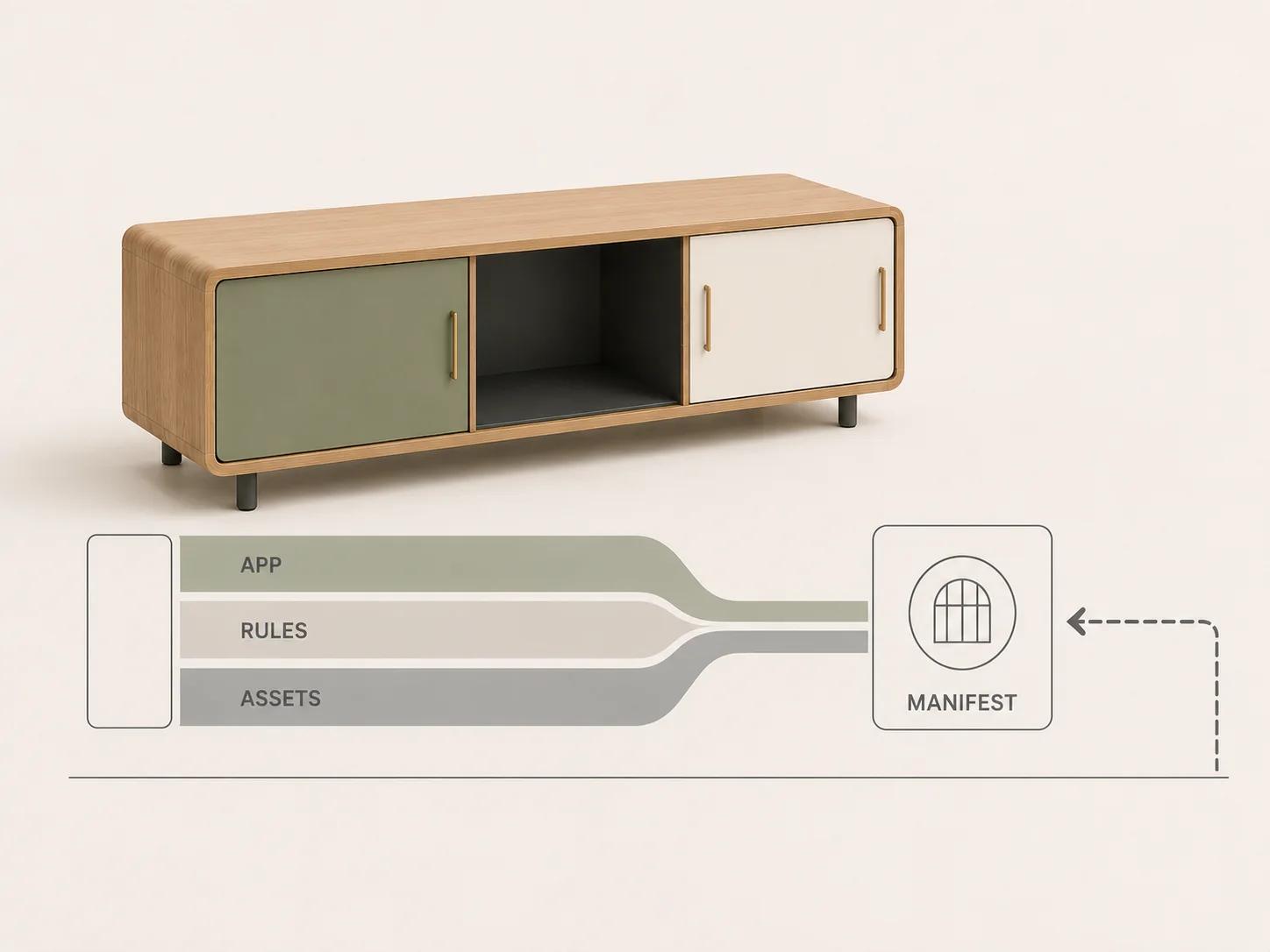
Publish assets to new immutable paths before switching the manifest. Deploy backward-compatible APIs before a client that requires them. Keep the prior compatible manifest available until the rollback window closes. If a rule change cannot be read by the current client, block the pairing at release time instead of discovering it through user errors.
Separate health from correctness. A 200 response proves that an endpoint answered, not that a selected configuration kept the right rule, visual and price state. Run a small set of synthetic configuration journeys through candidate resolution, asset mapping, save/reopen and the intended transaction boundary. Record the product case, versions and observed output.
When an existing system is already slow or fragile, use the stabilize-versus-rebuild guide to isolate the fault before replacing architecture. When the platform itself must change, use the replatforming guide for migration, data ownership and cutover risk. A new reference diagram alone does not prove that either intervention is warranted.
Keep essential choices and feedback outside the canvas
The 3D view can explain form, material and spatial relationships, but it should not be the only place where a user selects, reviews or repairs a configuration. WCAG 2.2 requires content functionality to be operable through a keyboard interface, subject to its path-dependent exception; it also requires automatically detected input errors to be identified and described in text, and status messages to be programmatically determinable without taking focus.[8]
Use semantic controls with visible focus, a textual configuration summary and text explanations for automatic changes. Provide an equivalent control for a drag-only camera or assembly action when that movement is not essential to the function. Announce loading, price refresh, invalid combinations and save results through appropriate status behavior. These steps address specific criteria; they do not by themselves establish complete accessibility conformance.
Approve the architecture with an end-to-end case
Before expanding the catalog, choose one representative product that crosses the risky seams. Retain evidence for these checks:
- a candidate state resolves against the named rule version;
- the controls, summary and 3D mapping consume the same resolved IDs;
- an incompatible or unavailable choice returns a useful reason;
- cold and warm asset delivery meet a stated test profile and threshold;
- save and reopen preserve ownership, versions and market context;
- a stale client or rule bundle follows the designed rejection or upgrade path;
- the authoritative price, quote or cart boundary validates the state again; and
- the deployed compatibility manifest can be observed and rolled back.
The Spellexo case study documents Double Edged's ownership of product strategy, UX, 3D production, engineering, testing, launch and ongoing operation.[10] It publishes no measured conversion or return-rate result and does not claim rescue or migration outcomes for an existing configurator.[10]
If the unresolved work spans product rules, state design, 3D production, integrations and release ownership, the custom 3D product configurator service is the commercial route. Bring a representative product, current rule source, downstream action and system-owner map; those inputs reveal more about architecture fit than a preferred framework name.



