

The best 3D product configurator software is the one that can prove your product rules, visual standard, transaction path and operating model with your data. A long feature list cannot make that decision for you. Neither can a polished demo built around a vendor's easiest product.
Start with one representative configuration and the downstream result it must produce. Then use disqualifying gates, a weighted scorecard and an evidence grade for every answer. This keeps visual quality from masking weak product logic, and it keeps a strong rules engine from winning a project it cannot integrate or operate responsibly.
This scorecard compares candidates inside a defined system boundary. Use the 3D product configurator e-commerce blueprint to trace the wider path through product data, state, price, cart, order and analytics before applying the method below.
Write the buying brief before naming vendors
A shortlist made before the brief usually reflects brand recognition, previous relationships or whoever gave the most convincing demonstration. Reverse the order. Write a one-sentence release case first:
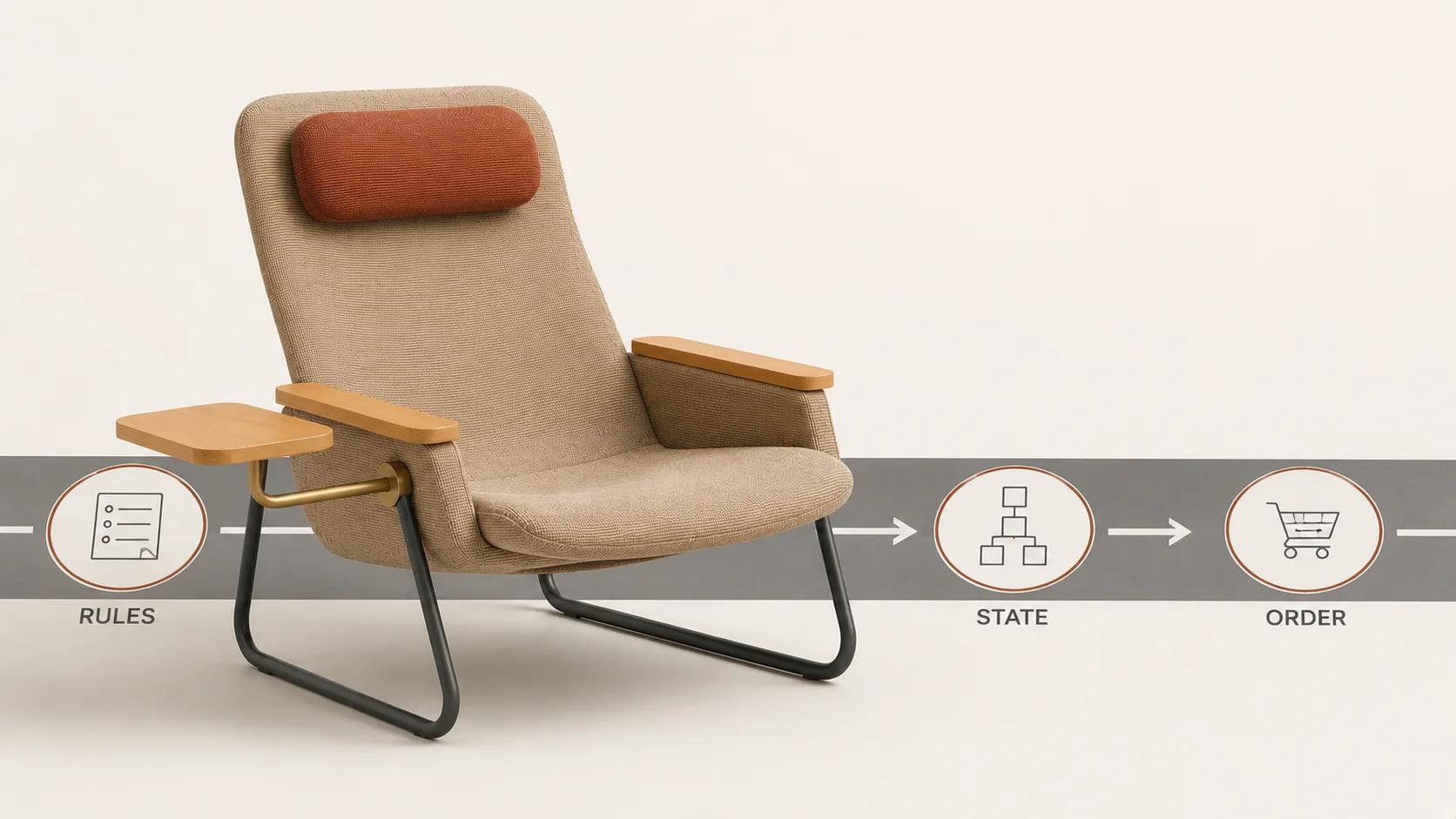
A buyer can configure one modular lounge chair, see every allowed upholstery and accessory change, receive an authoritative market price, save the configuration and place a versioned reference into the intended commerce flow.
That is a planning example, not a claim about a delivered project. Replace it with a real product family that exposes the difficult parts of your catalog. Include a dependency, an invalid combination, a visible material change, a pricing consequence and the actual downstream action.
The brief should state:
- the user, channel, market, language and supported device profiles;
- the product family, option volume, dependency types and engineered constraints;
- the systems that own product data, price, availability, customer identity and orders;
- the required visual states, material references, camera behavior and fallback media;
- the expected output, such as a cart line, quote, saved design, bill of materials or production handoff;
- the people who will add products, approve changes, investigate errors and release updates; and
- the exclusions for the first release.
This is not paperwork for its own sake. It gives every vendor the same problem to solve. Emersya's current first-party selection guidance, inspected on 31 August 2026, similarly starts with goals and use cases, then covers assets and product data, rules, UX and testing with real products and data.[1] That sequence is useful, but your brief must still describe your own truth rather than adopting any vendor's preferred implementation.
Keep three lists: mandatory outcomes, scored preferences and later possibilities. If a requirement can wait without forcing a new state model or integration contract, label it later. If omitting it would invalidate the architecture, keep it in the first-release brief even if its interface arrives later.
Replace feature answers with evidence grades
"Supported" is too vague for procurement. It can mean a sentence on a sales page, a controlled demonstration, an API endpoint, a partner-delivered customization or a capability already tested against your data. Give every scored answer an evidence grade:
| Grade | Evidence available | How to record it |
|---|---|---|
| 0 | No evidence or the answer is unknown | Treat as a gap, not a neutral score |
| 1 | Marketing claim or verbal assurance | Record the exact claim, owner and follow-up date |
| 2 | Generic demonstration or public example | Note what was shown and which hard requirement was absent |
| 3 | Current documentation plus a relevant working example | Capture the document version, example and known limits |
| 4 | Vendor-run test with your representative data | Retain inputs, output, environment, result and open defects |
| 5 | Reproducible pilot evidence plus an operating handoff | Retain the test, administration steps, support path and exit evidence |
The grade measures confidence in the answer, not product quality. A capability can fit your needs and still receive a low grade because nobody has proved it. That distinction gives procurement a clean choice: reject the risk, require proof before contract, or accept it with a named owner.
Current vendor documentation also shows why broad labels need decomposition. Roomle's integration guide, inspected on 31 August 2026, describes iframe or JavaScript embedding, pricing through either webshop logic or its Price Service, and configuration processing through cart or lead-generation paths.[2] One box called "e-commerce integration" would hide all of those architecture choices.
Shopify's current Storefront API documentation resolved to its 2026-07 CartLine reference when inspected. A cart line represents a product variant, tracks merchandise, quantity, cost and discounts, and can carry custom attributes.[3] That does not prove a candidate will preserve a complex configuration correctly. Ask which stable reference, snapshot, rule version and human-readable summary reach the cart and order, then test the result.

Use a weighted scorecard that reflects the actual project
The following vendor selection spreadsheet is an original Double Edged framework. Its eight weights total 100. Change the weights before vendor demonstrations, document why, and give every candidate the same version. Do not tune the sheet after seeing a favored platform's strengths.
Score each criterion from 0 to 5 for fit. Multiply the fit score by the criterion weight and divide by 5. Keep the evidence grade in a separate column; a high fit score with weak evidence remains an explicit risk.
| Criterion | Weight | What earns a strong fit score | Evidence to request |
|---|---|---|---|
| Product rules and validity | 18 | Dependencies, exclusions, formulas and invalid states match the representative rule set without duplicating truth in the UI | Rule model, negative cases, explanations, version behavior and owner workflow |
| Commerce and data integrations | 16 | Stable product and configuration identities survive price, availability, cart, quote, order and save/reopen boundaries | API contracts, redacted payloads, failure cases, sandbox test and version policy |
| Visual quality and asset operations | 14 | Approved geometry, materials and component changes render accurately within a maintainable asset pipeline | Reference comparison, asset specification, update test, fallback behavior and review process |
| UX and accessibility | 12 | Guided choices, dependencies, errors, summary and recovery work across supported input and device profiles | Keyboard script, error cases, responsive test, content controls and user test plan |
| Performance and reliability | 12 | The representative product meets named loading, interaction and stability budgets under declared test profiles | Repeated lab runs, field plan, asset timings, API timings, failure behavior and monitoring |
| Administration and governance | 10 | Named roles can preview, validate, approve, publish, localize and roll back changes | Role matrix, audit trail, staging workflow, revision history and rollback exercise |
| Commercial and operating model | 10 | Licensing, implementation, content work, environments, support, change work and exit obligations are legible | Itemized assumptions, responsibility matrix, service terms, renewal rules and export test |
| Security and privacy | 8 | Identities, saved designs, privileged actions, APIs, logs and suppliers have explicit controls and evidence | Security process, architecture answers, authorization tests, incident path and data map |
Copy the worksheet below into a spreadsheet and replace Candidate A, Candidate B and Candidate C with the shortlisted names. The long format keeps one judgment per row, which makes evidence links and unresolved risks easier to filter than a very wide comparison sheet.
| Candidate | Criterion | Weight | Fit (0-5) | Weighted fit | Evidence grade (0-5) | Evidence link | Unresolved risk |
|---|---|---|---|---|---|---|---|
| Candidate A | Product rules and validity | 18 | |||||
| Candidate A | Commerce and data integrations | 16 | |||||
| Candidate A | Visual quality and asset operations | 14 | |||||
| Candidate A | UX and accessibility | 12 | |||||
| Candidate A | Performance and reliability | 12 | |||||
| Candidate A | Administration and governance | 10 | |||||
| Candidate A | Commercial and operating model | 10 | |||||
| Candidate A | Security and privacy | 8 | |||||
| Candidate B | Product rules and validity | 18 | |||||
| Candidate B | Commerce and data integrations | 16 | |||||
| Candidate B | Visual quality and asset operations | 14 | |||||
| Candidate B | UX and accessibility | 12 | |||||
| Candidate B | Performance and reliability | 12 | |||||
| Candidate B | Administration and governance | 10 | |||||
| Candidate B | Commercial and operating model | 10 | |||||
| Candidate B | Security and privacy | 8 | |||||
| Candidate C | Product rules and validity | 18 | |||||
| Candidate C | Commerce and data integrations | 16 | |||||
| Candidate C | Visual quality and asset operations | 14 | |||||
| Candidate C | UX and accessibility | 12 | |||||
| Candidate C | Performance and reliability | 12 | |||||
| Candidate C | Administration and governance | 10 | |||||
| Candidate C | Commercial and operating model | 10 | |||||
| Candidate C | Security and privacy | 8 |
Enter a fit score and evidence grade for every row, using 0 when the answer or proof is absent. After pasting the table with its header in row 1, enter =C2*D2/5 in E2 and fill down through E25. Candidate totals are =SUM(E2:E9), =SUM(E10:E17) and =SUM(E18:E25); each has a maximum of 100. Keep the evidence grade separate. Folding it into the total would hide whether a strong fit score rests on a reproducible test or a sales claim.

Product rules and visual truth
Run approved valid and invalid cases. The candidate should show why a combination is unavailable, what happens to an earlier choice when a dependency changes and how the same rule reaches every channel. Ask who edits rules, how changes are reviewed and whether saved configurations can be reopened against older versions.
glTF is an API-neutral runtime asset delivery format for transmitting and loading 3D content.[4] Support for glTF or GLB is useful, but it is not proof that a platform will reproduce your finish, map options to the correct parts, enforce product logic or keep assets current. Compare the rendered result with approved reference views and inspect the content workflow behind it.
UX and accessibility
Do not accept "accessible" as a binary answer. WCAG 2.2 provides testable success criteria that can be used in purchasing and contracts; its requirements include keyboard operation and text identification of automatically detected input errors.[5] Turn the criteria relevant to your flow into acceptance tests. Check option controls, camera alternatives, dependency feedback, validation, summary, save/reopen and transaction steps. Those checks are part of a wider accessibility review, not proof of complete conformance.
Integration and performance
Ask the vendor to trace one configuration through every system boundary. Record the owner of price, availability and product validity. Define timeouts, stale-data behavior, retries, duplicate submissions and what the user sees when a dependency is unavailable. A successful happy path does not prove that the integration can fail safely.
Performance evidence needs a named product, build, browser, device, network profile and run count. Google's current Web Vitals guidance uses Largest Contentful Paint, Interaction to Next Paint and Cumulative Layout Shift, and says lab measurement is useful during development but does not replace field measurement.[7] Add configurator-specific measures such as first useful product view, material-change response, rule-resolution time and transaction error rate. Do not turn a single desktop demo into a general performance claim.
Security, privacy and supplier practice
Saved configurations, quotes and administration surfaces introduce object identifiers, privileged functions and costly business flows. OWASP's 2023 API Security Top 10 calls for object-level authorization checks when user-supplied IDs access data, and separately identifies unrestricted resource consumption, sensitive business-flow abuse and improper API inventory management.[6] Ask candidates to demonstrate denied access, rate and resource controls, API version inventory and audit behavior rather than sending a generic security slide.
NIST describes its Secure Software Development Framework as a core set of high-level practices that can be integrated into a software development life cycle.[8] Use it as a conversation structure for development, vulnerability handling and supplier evidence. It is not a certificate, and a questionnaire cannot replace technical and contractual review.
Set disqualifying gates before comparing totals
A weighted average can hide a fatal gap. Define gates that a candidate must pass regardless of its total score. Typical gates include:
- the representative invalid combinations cannot reach the transactional output;
- authoritative pricing and availability ownership are agreed;
- the supported commerce path retains an interpretable configuration reference;
- required product and personal data can be handled within approved boundaries;
- supported controls and recovery paths meet the accessibility acceptance plan;
- the product can load and respond within the project's declared test budgets;
- administrators can preview, approve and roll back relevant changes; and
- the contract provides an acceptable data, configuration and asset exit path.
Record each gate as Pass, Conditional, Fail or Not tested. A conditional result needs an exception owner and close date. A fail blocks selection regardless of the weighted total.
| Gate | Candidate A | Candidate B | Candidate C | Required evidence or exception owner |
|---|---|---|---|---|
| Invalid combinations cannot reach the transactional output | ||||
| Pricing and availability authority is agreed | ||||
| The commerce path retains an interpretable configuration | ||||
| Product and personal data boundaries are approved | ||||
| Accessibility acceptance tests pass | ||||
| Declared performance budgets pass | ||||
| Administrators can preview, approve and roll back | ||||
| The data, configuration and asset exit path is acceptable |
"Typical" matters here. Legal, security, manufacturing and market obligations vary. Name the owner who can approve each gate, the evidence they require and whether a conditional pass is allowed. Never let a salesperson or a procurement spreadsheet silently approve a technical or regulatory exception.
Run one representative configuration challenge
Give shortlisted vendors the same sanitized data pack. It should contain stable identifiers, approved visual references, a small asset set, rules with positive and negative examples, a pricing or availability stub, a transaction payload and the supported device profiles. Remove confidential material that is not needed for the test.
Use a product case that exposes disagreement. For the modular lounge chair example, the challenge might include upholstery restricted by market, a headrest allowed only with one back type, a tray that changes the arm selection, a finish with a price consequence and an unavailable combination that must be explained. The candidate must not invent missing rules. Unknowns should return to the named product owner.
Ask each team to demonstrate the same sequence:
- import or model the product structure and explain where the rules live;
- produce one approved valid configuration and reject the supplied invalid cases;
- change a dependency and show the effect in controls, summary and 3D;
- retrieve authoritative price or availability and expose failure behavior;
- save, reopen and version the configuration;
- send the required reference and summary into the downstream flow;
- edit one rule and one material through the proposed administration process;
- preview, approve, release and roll back that change; and
- export the configuration, rules and owned assets in the proposed exit format.
Record observed behavior, not demo narration. Keep input files, dates, environment, screenshots or recordings where permitted, payload samples, timing method, defects and unanswered questions. If the vendor performs custom work for the challenge, label which capability belongs to the core product, a paid module, a partner or project-specific engineering.
Compare the whole operating model, not the subscription line
Build a cost and responsibility sheet beside the technical scorecard. Separate software subscription or usage fees from implementation, product modeling, material creation, data preparation, rule authoring, UX, integration, environments, testing, training, support and change work. Record the unit behind every variable charge and the assumption behind every quantity. Do not insert an invented catalog volume merely to force a total.
Ask who owns each recurring task. A platform may reduce renderer development while leaving your team responsible for product data, 3D preparation, rule maintenance and release QA. Another proposal may include managed production but constrain update timing or portability. Neither model is automatically better. The fit depends on available skills, catalog change rate, governance and how much operational control the business needs.
Cover the end as carefully as the start. Request export formats for product definitions, rules, saved states, analytics history and owned media. Identify what remains usable without the vendor's runtime, what requires migration and who pays for extraction or transition support. Test at least one export during evaluation if exit control is material.
The Custom Configurator Scope and Budget Estimator maps visitor-supplied rules, assets, visualization, integrations, pricing, outputs and ownership into an explainable complexity profile. It does not produce a quote; project pricing still depends on validated requirements and responsibilities.[9]
Normalize proposals before the final decision
Require every proposal to mark assumptions, exclusions, customer responsibilities, third-party dependencies and optional items. Normalize terminology in your sheet. "Implementation" may include configuration in one proposal and exclude data preparation, UI work or integration in another. "Support" may cover platform incidents but not product-content defects. The label is not the scope.
For each scorecard row, retain five fields: fit score, evidence grade, evidence link, unresolved risk and owner. Add the weighted totals only after gates have been reviewed. Then compare three views:
- fit: how well the candidate meets the defined release case;
- confidence: how much of that fit has been proved with relevant evidence; and
- exposure: what remains unresolved across delivery, operation and exit.
A candidate with the highest weighted fit can still lose because it fails a gate or relies on weak evidence for a critical requirement. A lower total may be rational when its hard requirements are proved and its operating model matches the team. Record that reasoning in a short decision log rather than adjusting scores until the preferred name wins.
Use one final summary row per candidate. Do not write a decision until every gate has a status and each critical weak-evidence row has an owner.
| Candidate | Gate result | Weighted fit /100 | Critical weak-evidence rows | Unresolved exposure | Decision |
|---|---|---|---|---|---|
| Candidate A | |||||
| Candidate B | |||||
| Candidate C |
The scorecard also allows an honest "none" result. If every platform requires extensive custom behavior at the boundaries that matter, compare a custom or hybrid architecture rather than forcing a platform purchase. The 3D web configurator architecture guide goes deeper into browser, state, backend and deployment responsibilities when that becomes the deciding issue.
Put these questions in the vendor brief
Before requesting a final proposal, make sure the brief can answer:
- Which supplied rule cases were proved, and which remain assumptions?
- Who owns product validity, price, availability and the saved configuration over time?
- Which visual references were accepted, and how will future assets be reviewed?
- Which integration path, API version, failure behavior and transaction payload were tested?
- Which accessibility and device profiles form the acceptance contract?
- How were performance results measured, and what field plan follows launch?
- Which roles can alter rules, assets, pricing connections and releases?
- What security, privacy, incident and supplier evidence has been reviewed by the right owners?
- What work and cost recur when the catalog changes?
- What can be exported, in what form, and under which contract terms?
If the answers are specific and evidenced, the software decision can survive beyond the demo. If they remain adjectives, the team is still shopping for a promise.
When no off-the-shelf candidate passes the gates without bending product truth or the transaction path, the custom 3D product configurator service is the route for project-specific discovery and delivery. Bring the completed scorecard so discovery can start with recorded gates, evidence and unresolved risks.



