
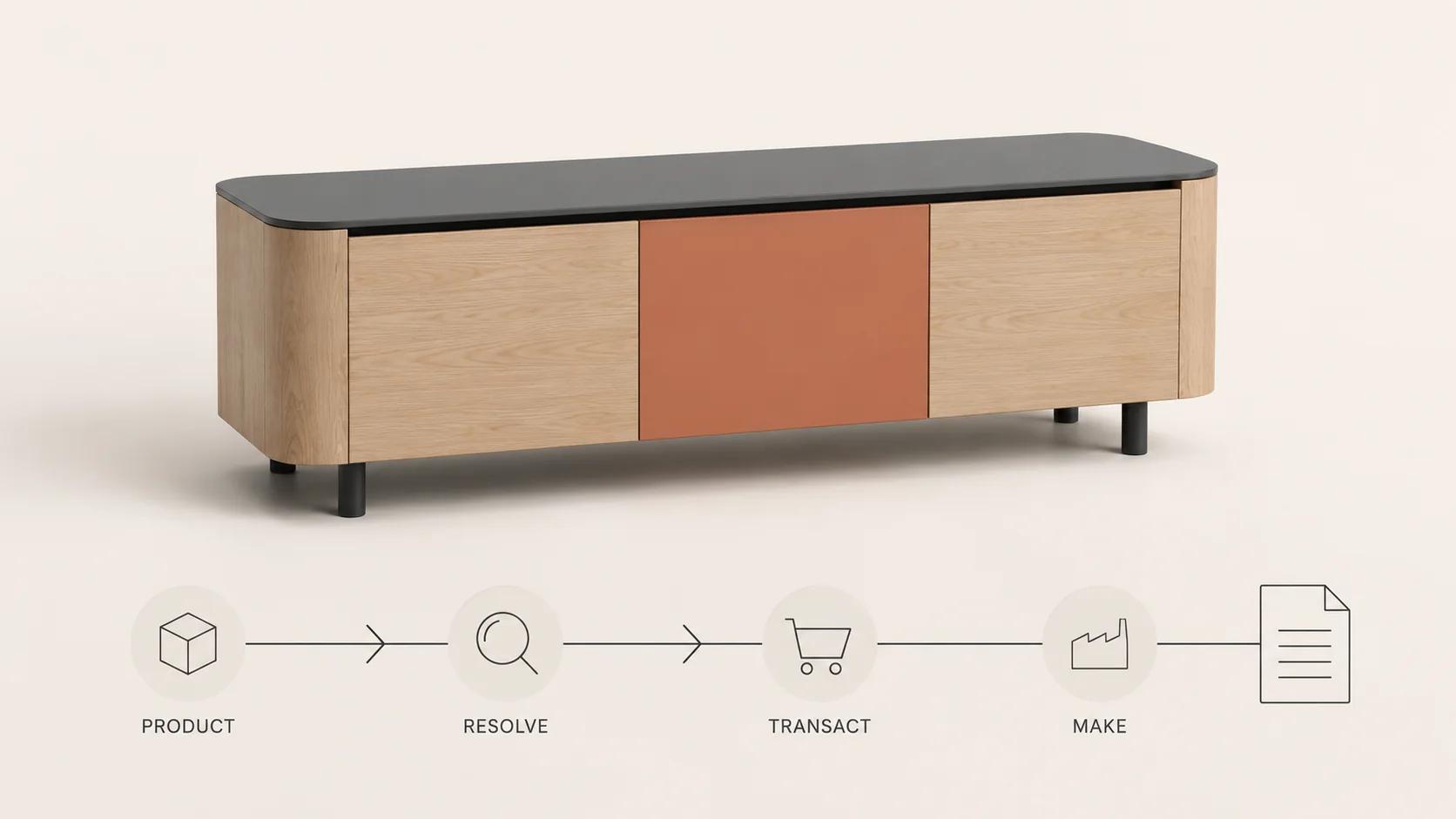
A 3D product configurator for e-commerce should be designed as a transaction system with a visual interface. One configuration has to remain intelligible as it moves through product rules, the 3D scene, authoritative pricing, cart, order, analytics and production. If each layer invents its own version of the selection, the experience may look correct while the business receives an order it cannot price, explain or make.
The working invariant is simple: every commercial step consumes a resolved configuration with stable identifiers and records the versions needed to interpret it. The browser may hold a fast candidate state, but it does not get to declare that a combination is sellable, priced, available or ready for production.
This blueprint maps those handoffs. It does not select a vendor, prescribe one web stack or promise a commercial result. Use the broader 3D product configurator guide for the general definition of rules, visuals and outputs. The sections below follow the path from a buyer's choices to an accepted e-commerce and production record.
Treat the configurator as part of the transaction
A viewer can stop at rendering. A commerce configurator cannot. It needs to answer four questions at the same time:
- Is this combination allowed for this product, market and customer context?
- Does the visible product match the resolved option identifiers?
- Which system supplied the displayed price and availability, and when?
- Can cart, order and production teams reconstruct what the buyer approved?
Those questions cross departments. Merchandising may own names and assortment. Product engineering may own compatibility. Commerce may own price, tax context, availability and checkout. A 3D team may own meshes, materials and visual mappings. Operations may own the bill of materials, artwork or manufacturing handoff. The integration needs each owner to publish a contract rather than letting one team copy the others' data into a private spreadsheet or scene file.
Start with one representative product and one real purchase path. Include a dependency, a visible change, a price or quote consequence, an unavailable state and the intended downstream output. A technically easy SKU can hide the exact seams the project needs to test.
Define the integration spine before choosing software
The following commerce integration blueprint is an original Double Edged planning framework. It is not a universal vendor architecture. Its purpose is to expose ownership, payload and release evidence before a team debates platforms.
| Contract | Authoritative owner | Minimum durable data | Release evidence |
|---|---|---|---|
| Product identity | Catalog, PIM or approved product service | Product family ID, sellable item IDs, market, locale and lifecycle state | A known product resolves to the same identifiers in the configurator and commerce platform |
| Rule resolution | Product or configuration rule service | Candidate selections, resolved selections, defaults, exclusions, explanations and rule version | Positive and negative examples return the expected valid state and reason |
| Visual mapping | 3D asset and presentation pipeline | Resolved option IDs, asset version, material and component mappings, transforms and fallback media | Reference views match the visible state for representative cases |
| Commercial resolution | Pricing and availability owners | Configuration reference, price response, currency, market, customer context, validity window and availability status | The displayed commercial state can be traced to its source response |
| Cart handoff | Commerce platform | Configuration reference, product or line identity, quantity, price token or quote state, summary and reopen URL where supported | A cart line can be reopened and compared with the resolved configuration |
| Order record | Order-management owner | Immutable-enough configuration snapshot, transaction IDs, accepted price, consented files and version references | Customer service and operations can reconstruct the accepted order without reading UI labels |
| Measurement | Analytics owner | Typed event, configuration/session reference, product IDs, stage, result and consent context | Events reconcile with real cart and order records without treating interaction as revenue |
| Production handoff | Manufacturing, fulfilment or review owner | Approved specification, units, files, components, tolerances, exception state and revision | The receiving team can accept, reject or return the handoff with a named reason |

A contract is incomplete if it names only the happy-path fields. Record who can change the data, which version is in force, how long a response remains valid, what a timeout means, and whether the user can continue. This is where scope grows: the difficult work is often not drawing another material. It is deciding which system wins when rules, price, inventory and a saved configuration disagree.
The Custom Configurator Scope and Budget Estimator maps visitor-supplied information about product options, dependencies, visualization, assets, integrations, pricing, outputs and operating ownership into an explainable complexity profile and recommended path. It does not issue a project quote; cost and timing still depend on verified rules, representative assets, systems, stakeholders and acceptance criteria.[8]
Give every domain one source of truth
Product truth, experience state and rendered state are related, but they are not interchangeable. Product truth says what may be sold. Experience state says what the buyer is currently doing. Rendered state says which visual resources depict the resolved product.
JSON Schema validation can assert structural constraints on instance data, and its object vocabulary includes dependent requirements for properties that become required when another property is present.[1] That makes it useful for checking the shape of a configuration payload. It does not decide whether a 160 cm frame can safely carry a particular module or whether a finish may be sold in one region. Those decisions still need owned domain rules and executable examples.
glTF is an API-neutral runtime asset delivery format intended to carry 3D content between creation tools and graphics applications.[2] A GLB can package the visual scene efficiently, but its node names and material slots should not become the commerce catalog by accident. Map stable product option IDs to visual resources through a versioned adapter.
Keep labels out of the transaction key
A label such as "Large / Sand / Left" is written for a person. It may be translated, shortened or renamed. Use stable identifiers for the product, option, value, component and rule set, then attach human-readable labels as presentation data.
The same principle applies to materials. A renderer may call a slot fabric_02, while the catalog calls the selection UPHOLSTERY-SAND-14. Store the mapping explicitly. If an artist reorganizes the scene, commerce history should still make sense. If merchandising renames the finish, an old order should still point to the accepted option.
Separate candidate state from resolved state
A buyer action creates a candidate state. The rule layer either rejects it or returns a resolved state, including any automatic changes and their reasons. The interface and 3D view consume that resolved result. Price, cart and order services validate it again at their own trust boundaries.
That distinction makes dependencies explainable. If a longer top removes an incompatible leg set, the response should identify the requested option, the removed option, the accepted state and the rule that caused the change. Hiding the adjustment may leave the 3D view and order summary apparently consistent while the buyer never knowingly approved the result.
Resolve state before price, cart or order
The safest sequence is candidate, resolved, commercially evaluated, carted and ordered. Each step receives a reference to the prior state and produces evidence for the next one.
- The user proposes a change against a known product and rule version.
- The rule owner returns a resolved configuration or a typed rejection.
- The visual adapter renders that resolved state and reports any missing mapping.
- The pricing and availability owners evaluate the same stable IDs in the required market and customer context.
- The cart accepts a configuration reference plus the commercial response it is allowed to trust.
- Checkout revalidates anything that can change, then writes an order snapshot rather than a screenshot of the interface.
- Production or human review receives the approved specification and returns a traceable acceptance or exception.
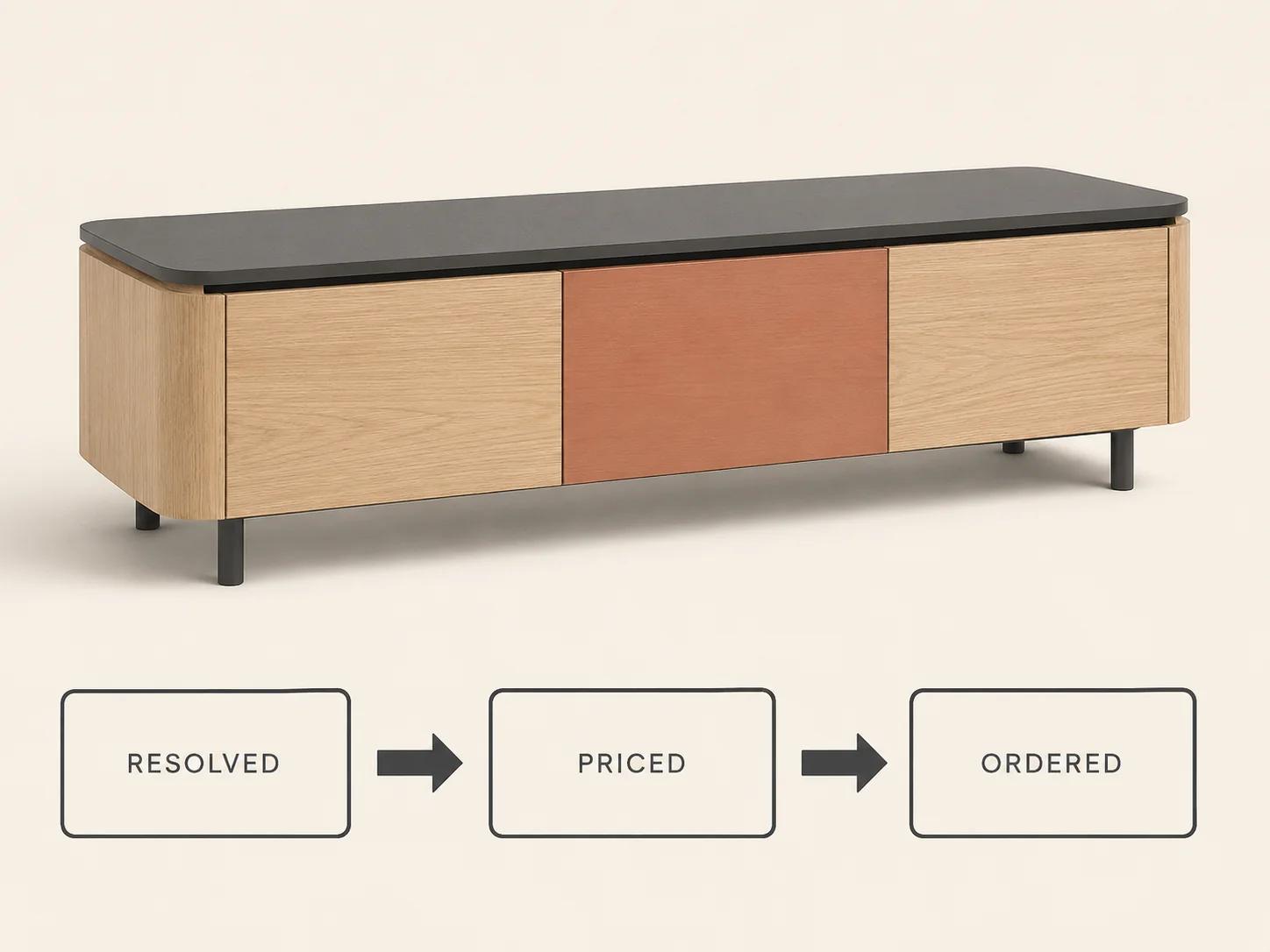
Do not make price a property that the browser can simply edit inside configuration state. Record the authority, currency, market, customer or contract context, calculation or price-list version, issue time and expiry behavior. If live price fails, decide in advance whether the experience hides price, marks it unavailable, preserves a recently validated amount with a clear status, or moves to a quote path. "Try again" is not a commercial policy.
Cart behavior needs the same precision. Decide whether a line stores a configuration ID, a signed or otherwise trusted snapshot, both, or a platform-specific reference. Define what happens when someone changes quantity, duplicates a line, returns from checkout or opens a saved configuration after the rules changed. The detailed implementation belongs to each platform guide; this blueprint establishes the questions every platform must answer.
Define the reopen contract
A saved configuration is a promise that the system can explain later, not a guarantee that yesterday's product remains sellable forever. Store the product family, stable option IDs, rule version, visual-mapping version, market and any commercial response needed to interpret the save. Give the record an owner, access policy, creation time and status such as active, expired, superseded or review required.
Decide what the buyer sees when reopening it. The system may reproduce the saved visual state, but it should recheck current rules, availability and price before presenting a new purchase action. If the current catalog cannot resolve an old option, show the affected choice and a named repair path instead of silently choosing the nearest value. Shared links also need an explicit boundary: decide whether they expose a public read-only state, require authentication or expire.
Keep the historical snapshot separate from the newly resolved candidate. That lets customer service explain the original save while the buyer reviews any current changes. It also gives analytics a clean distinction between configuration_reopened, configuration_migrated and a genuinely new build.
Write contracts around the risky seams
OpenAPI 3.2 defines a standard, programming-language-agnostic interface description for HTTP APIs and can be used by documentation, code-generation and testing tools.[3] An API description is useful only when the business behavior is also explicit. For each rule, price, cart, save and order operation, specify:
- request and response schemas, stable identifiers and version fields;
- authentication and authorization requirements;
- timeout, retry, idempotency and duplicate-submission behavior;
- typed rejections and whether the user can repair them;
- stale-data, partial-response and dependency-unavailable behavior;
- audit fields, retention, sensitive-data limits and logging redaction; and
- deprecation, migration and rollback policy.
HTTP defines a method as idempotent when multiple identical requests have the same intended server effect as one request, and warns against automatically retrying a non-idempotent method without another basis for knowing the request is safe to repeat.[6] A cart add, quote creation or production submission therefore needs deliberate duplicate protection. The chosen mechanism might be an idempotency key, a unique configuration-stage token or a read-before-retry protocol. The contract must say which.
Authorization also follows the object through the flow. OWASP's 2023 API Security Top 10 says object-level authorization checks should be considered whenever a function accesses data through a user-supplied ID; it separately identifies unrestricted access to sensitive business flows and unsafe consumption of APIs.[4] Apply that boundary to saved configurations, private quotes, uploaded artwork, customer-specific prices, admin publishing and order retrieval. A hidden button is not an authorization control.
Use redacted fixtures built from representative identifiers. Test one accepted request, each expected rejection, an expired price, an unavailable dependency, a duplicate write, a late response and an older contract version. One successful sandbox call proves very little about the seam that fails under change.
Instrument decisions without turning events into outcomes
Analytics should describe the buyer's path and the system's response without becoming a second commerce database. Start with a small event contract that connects interaction to resolved state:
- configurator opened for a known product context;
- option change proposed, accepted, adjusted or rejected;
- visual state ready or mapping unavailable;
- price requested, returned, expired or unavailable;
- configuration saved, shared or reopened;
- cart attempt accepted or rejected; and
- checkout and order milestones received from the commerce authority.
Google's current GA4 e-commerce guidance describes actions such as viewing items, adding or removing items from a cart, beginning checkout, making purchases or refunds, and representing products as an items array within those events.[7] If GA4 is the selected destination, map the project's internal event model deliberately rather than copying a configurator's mutable labels into analytics fields.
Keep technical and commercial measures separate. A material selection proves interaction, not purchase intent. A successful add_to_cart event does not prove that the cart accepted the right configuration. A purchase event should reconcile with the authoritative transaction ID and order contents. Conversion, revenue, return rate and average order value need actual measured data and an analysis design; the presence of 3D does not establish an uplift.
Consent and data minimization belong in the event design. Avoid sending private configuration text, customer files or production instructions to a general analytics destination. Use stable pseudonymous references only where policy and consent allow, and keep the operational record in the system that owns it.
Carry the accepted order into production
A production handoff should be generated from the accepted order state, not rebuilt from the image a buyer saw. Preserve enough information to answer what was selected, which rules and assets interpreted it, what price was accepted, which files were approved and what changed after submission.
A practical handoff packet contains:
- order, line and configuration identifiers;
- product family and selected option IDs with human-readable summaries;
- rule, catalog, pricing and visual-mapping versions;
- quantity, units, dimensions and market context;
- accepted artwork or customer-supplied files with revision and rights status;
- calculated components or bill-of-material references where in scope;
- visual proof or approval references, clearly separated from manufacturing truth;
- exception, manual-review and approval states; and
- creation, acceptance and supersession timestamps.

Not every configurator should generate manufacturing data. Some should stop at a quote request or a reviewed specification. The output status must say that plainly. A document labeled "production ready" creates an obligation that a glossy render cannot satisfy.
Plan change handling before launch. If a component is withdrawn after purchase, the operations team needs a controlled exception path. If a buyer reorders from an old configuration, the system needs to say whether it reproduces the old specification, migrates it to current rules or requires review. Silent substitution destroys the trace the integration was built to preserve.
Test the complete buying process
A green 3D test does not approve the purchase path. Follow representative cases through rules, visual mapping, price, cart, checkout, order and production. Compare the same case ID at each boundary.
WCAG 2.2 applies conformance to complete processes as well as full pages; its example says that an online store's sequence for selecting and purchasing products must conform from start to finish for any page in that process to conform.[5] Test the configurator controls, automatic dependency feedback, summary, cart repair and checkout handoff with the supported input methods and responsive layouts. Do not treat an accessible storefront shell as proof that a canvas-heavy configuration step or error recovery works.
A release case should retain four kinds of evidence:
- The rule result: input, resolved state, reason and rule version.
- The visual result: asset version, reference view and any mapping exception.
- The commercial result: authoritative price or quote state, currency, availability and cart response.
- The operational result: order snapshot, handoff status and named acceptance or rejection.
Add browser, device and network profiles where they affect the experience, but report them as tested profiles rather than universal compatibility. For the deeper browser, state and deployment decisions, use the 3D web configurator architecture guide.
Choose a platform after the contracts are visible
A product with independent options, standard pricing and no governed output may fit an existing platform or a light integration. Dependent rules, dynamic calculations, customer-specific prices, several systems, production files or multi-team publishing change the decision. That is why software evaluation should begin with representative contracts and failure cases.
Use the 3D product configurator software scorecard when the next decision is vendor fit. When the host system constrains cart, price and deployment, use the WordPress configurator comparison to compare plugin and custom paths. Neither question should be answered by a polished demo alone.
Ask a prospective platform or implementation team to run the same representative configuration through rule resolution, visual mapping, price, cart and reopen behavior. Inspect the resulting identifiers and records. A demo that ends at a rotating model has not tested the e-commerce integration described here.
Assign brand and system ownership before launch
The brief should name the owner of product truth, rules, 3D mappings, commercial data, cart integration, order schema, analytics, production acceptance and live operation. It should also name the brand owner who approves labels, visual references, fallback media and the claims made on the product page. If those roles are unresolved, the configurator is not ready to be presented as an authoritative buying path.
Spellexo is an owned Double Edged proof point for product strategy, UX, 3D production, engineering, testing, launch and ongoing operation. The Spellexo case study labels that evidence as live-product capability, publishes no measured commerce-lift result and says the product does not prove rescue or migration outcomes.[9] Its useful lesson here is operational: asset intake, viewer behavior, integration, testing and post-launch ownership remain connected. A prospective configurator still needs its own discovery, evidence and acceptance criteria.
When the unresolved work requires product-rule discovery, UX, 3D production and commerce integration, the custom 3D product configurator service is the commercial route. Bring the representative product, rule examples, source-system owners, price and cart behavior, intended output and launch constraints. Those inputs reveal whether the next step is platform fit, a phased MVP or paid discovery.



