
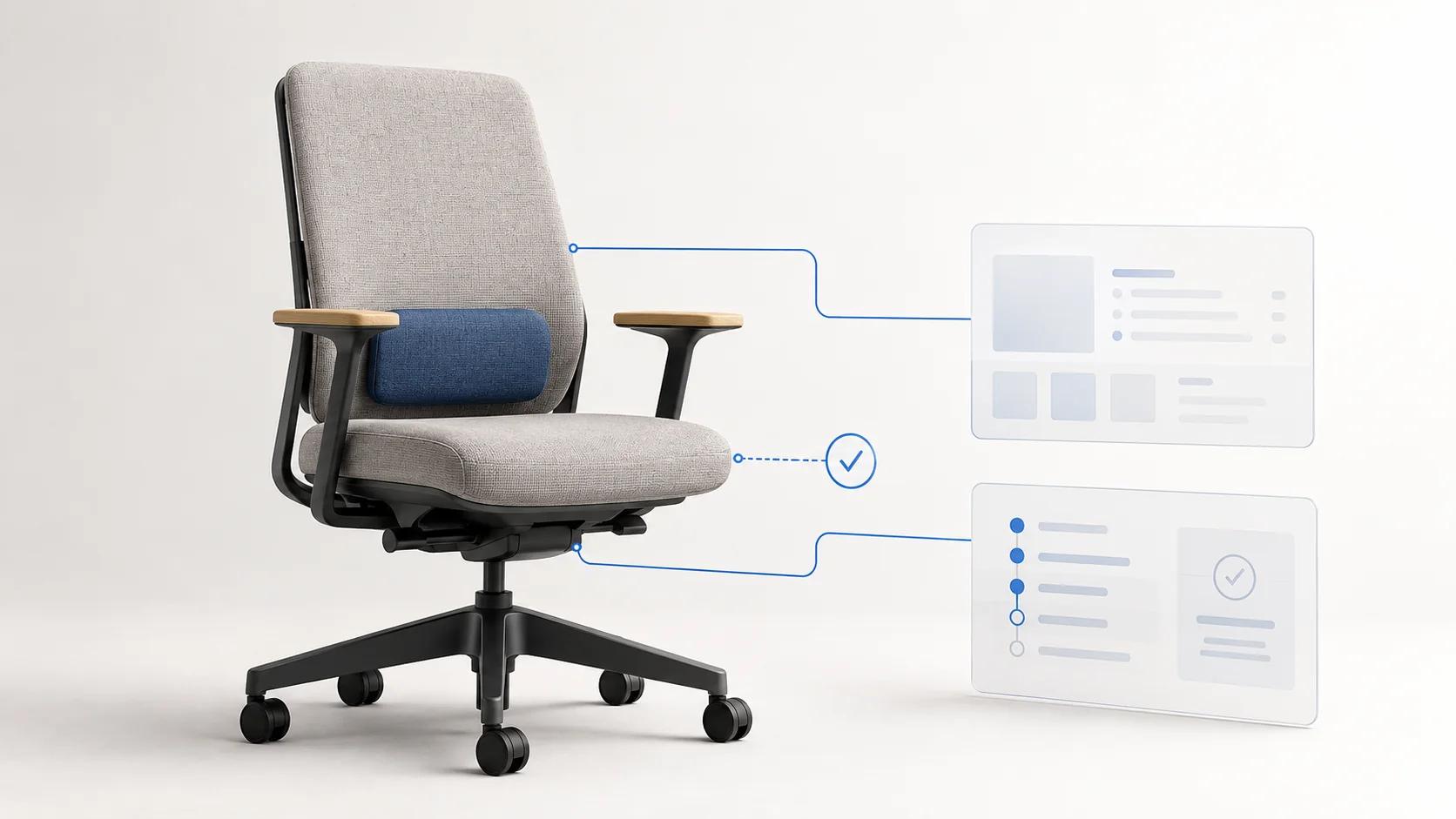
A Magento 3D product configurator is an integration project before it is a 3D project. The model may be the most visible part, but the release succeeds only when the selected design resolves to a sellable catalog record, an authoritative price, a durable cart item and an order that another system can fulfil.
The cleanest design gives each decision one owner. Magento or Adobe Commerce should usually own the commerce record. A configuration engine should own complex validity rules. The 3D layer should render the accepted state. If two systems can silently decide the SKU or price, the interface may look finished while the order data is already unreliable.
This guide covers the Magento-specific contracts. The broader e-commerce configurator integration blueprint covers the category-level architecture without repeating the platform details here.
Start with three sources of truth
Write down the owners before choosing an extension or drawing the interface:
- Commerce truth: product identity, website and store view, stock, tax, customer context, sellable price, cart, quote and order.
- Configuration truth: allowed combinations, dependencies, measurements, calculated quantities, engineering constraints and saved revisions.
- Visual truth: geometry, materials, component visibility, camera behavior and the image or 3D asset version shown for a selection.
For a finite variant family, Magento's native catalog can carry much of the first two layers. Adobe's 15 June 2026 documentation defines a configurable product as one product with selectable variations, where each variation is a separate simple product with its own SKU and individually tracked inventory.[1] That model fits a chair offered in five fabrics and three leg finishes when every valid combination is a stocked or otherwise managed variant.
An engineered desk with continuous width, conditional supports, region-specific hardware and calculated cable quantities is different. Turning every possible design into a child SKU can produce a catalog that is hard to author and harder to change. In that case, Magento can own the base merchandise and transaction while a separate rule engine owns the exact design. The integration still needs a stable configuration ID and revision so both systems refer to the same accepted state.
Use an ownership matrix before writing code
The matrix below is a discovery tool, not a universal data model. Complete it for one representative product and mark any row with two proposed authorities as unresolved.
Complete each row with one decision authority and one stored handoff.
| Contract | Recommended authority | What crosses the boundary | Release test |
|---|---|---|---|
| Catalog identity | Magento product and SKU records | Parent SKU, child SKU when one exists, store view | Accepted selection resolves to the intended sellable record |
| Configuration validity | Native variant model or dedicated rule engine, chosen per product | Option IDs, calculated values, rule-set version | Invalid combinations cannot reach cart by a crafted request |
| Visual state | 3D scene and asset binding layer | Configuration revision, material and component bindings, asset version | Reloaded state matches the approved summary |
| Price | Magento, CPQ or ERP, explicitly nominated | Price request context, returned amount, currency, tax basis and expiry | Server recomputation matches the displayed commitment |
| Customer access | Magento customer, company and catalog context | Authenticated customer or company scope, never a browser-only label | A user cannot see or buy another group's restricted offer |
| Cart persistence | Magento cart item plus durable configuration record | Configuration ID, revision, summary and reopen route | Cart reload and quantity changes preserve the accepted design |
| Order handoff | Magento order item plus downstream production reference | Immutable purchased revision, price evidence and fulfilment fields | Support and production can reconstruct what was bought |
| Approval path | Adobe Commerce B2B or an agreed external workflow | Quote or purchase-order reference, status and approver outcome | Approval applies to the exact revision and amount |

This exercise exposes cost drivers early. Custom rule services, account-specific pricing, quote workflows and manufacturing outputs each add a system boundary. Real-time 3D adds asset preparation, state binding and device testing. None of those should be hidden inside a single line called "Magento plugin."
The estimator turns those boundaries into a complexity profile and phased discovery brief. It does not invent a supplier quote from unknown requirements.
Keep Magento's catalog model where it fits
A native configurable product is useful when a complete selection maps cleanly to one child product. Adobe's 15 June 2026 documentation also states that the configurable product has no catalog price of its own; its displayed price is derived from in-stock child products.[1] That makes the child SKU a natural unit for inventory and base pricing in a finite catalog.
Do not force that pattern onto continuous or calculated products merely because the storefront needs an "add to cart" button. A custom configuration can instead use a base SKU for merchandising, a configuration ID for the designed object and derived line details for production. Decide whether those details belong in child order items, custom option data, a linked configuration record or a downstream bill of materials. The answer depends on fulfilment, returns, reporting and the systems that consume the order.
Define the mapping rule explicitly
Use one of these outcomes for every accepted design:
- it resolves to an existing child SKU;
- it resolves to a base SKU plus a stored configuration revision;
- it expands into a deterministic bundle or component list; or
- it cannot be purchased online and moves to quote or technical review.
The fourth outcome is valid. Hiding an unresolved engineered product inside a generic cart line is not.
Make price a server decision
The visual layer may display a running total, but it should not be the final price authority. The server must calculate or validate the amount using current product, website, currency, customer and configuration context.
Adobe's B2B documentation dated 20 August 2026 says the installed and enabled extension can personalize the buying experience with customer-specific catalogs and pricing.[6] Its shared-catalog documentation dated 15 June 2026 describes gated catalogs with custom pricing for different companies.[7] Those are Adobe Commerce B2B capabilities, so a team using Magento Open Source should not design around them without another source for account entitlements and contract prices.
Choose one pricing pattern:
- Native price: the child SKU, option or catalog rule already represents the complete sellable choice.
- External price: CPQ or ERP evaluates the accepted configuration and returns an amount with a currency, context, version and validity period.
- Hybrid price: Magento supplies catalog and customer terms while another service calculates configuration-dependent additions.
As checked on 31 August 2026, Adobe's Commerce webhook documentation says synchronous calls are available when Commerce must immediately calculate or validate data such as order totals, tax or payment through an external endpoint.[4] It also says to use a synchronous webhook only when the external response is critical; asynchronous events suit work that does not need to block the transaction.[4] A price check that determines whether checkout may continue can justify a blocking call. Sending a production notification after order placement usually should not hold the shopper's request open.
For every pattern, store enough evidence to explain the purchased amount: pricing authority, request context, response version, currency, tax treatment and any expiry. Recalculate after login, customer-group change, quantity change, cart restore and immediately before the order commitment.
Make the cart item replayable
Adobe's GraphQL documentation dated 14 March 2024 shows addProductsToCart examples for configurable products using either a parent and child SKU or a parent SKU with selected option identifiers.[5] That is enough for a native variation. It does not by itself describe a custom engineered design with its own rule revision, derived quantities and visual state.
For that product, persist a compact contract alongside the Magento cart item:
- base_sku;
- resolved_child_sku, when applicable;
- configuration_id;
- configuration_revision;
- rule_set_version;
- selection_summary;
- pricing_reference;
- visual_asset_version;
- reopen_route; and
- workflow_mode.
Treat the configuration record as durable data, not a screenshot or free-text note. A screenshot helps a person recognize the design, but it cannot prove which rule set ran or recreate calculated components. The browser payload is also untrusted. Revalidate configuration identity, allowed choices, customer access and price on the server before writing the cart.

Test cart editing before launch. Decide whether changing quantity preserves one design, duplicates it or creates independent revisions. Decide what happens when an option becomes unavailable, a saved configuration expires or the shopper switches store view. A clear failure with a route back to the configurator is safer than silently replacing the purchased design.
Treat customer context as part of the configuration
A finish, component or price may be valid for one website, company or customer group and unavailable to another. The configurator therefore needs Magento's authenticated context at evaluation time. Do not send every contract option and price to the browser and hide disallowed values with CSS.
Adobe's shared-catalog documentation dated 15 June 2026 says custom catalogs can be limited to members of assigned company accounts.[7] If that feature is in scope, test product visibility, option availability and price under at least a guest, a normal account and each materially different company group. Login during a saved session must trigger a fresh entitlement and price check.
Keep commercial eligibility separate from engineering validity. A component can be physically compatible yet contractually unavailable to one account. Record both decisions so support can tell the difference between a rule failure and a catalog-access failure.
Connect the 3D layer through APIs, not duplicated commerce logic
As checked on 31 August 2026, Adobe says its Commerce Web APIs support third-party integrations and headless applications through documented web interfaces.[3] Adobe's configurable-product GraphQL documentation, checked the same day, says the selection object contains metadata for selectable options and explains that swatches can show color, texture or another visual aspect.[2]
That gives a native visual configurator a useful path: query the catalog state, bind Magento option identifiers to scene changes, then submit those identifiers back to cart. A separate rules engine can use a similar interface, but it should return its own signed or server-verifiable configuration identity rather than pretending every calculated design is a Magento child variant.
Keep the 3D asset map versioned. A catalog option may remain valid while its model, material or component binding changes. Without an asset version, a reopened order can render differently from the scene the buyer approved. Load the heavy interactive layer after intent where the product page can still answer basic buying questions without it, then test the opened experience as a separate performance budget.
A visual configurator becomes visual CPQ only when configuration, authoritative pricing and quote or order workflow are connected. The 3D product configuration software versus visual CPQ guide owns that comparison. Here, the Magento decision is narrower: which platform record receives the accepted configuration, price and approval state.
Map enterprise approval before polishing the interface
Adobe's B2B documentation dated 15 June 2026 says purchase-order approval rules can control who creates purchase orders and how much they may spend.[8] The same documentation says manager-based approval rules require a defined company structure.[8] A visual CPQ build should therefore distinguish four moments: configured, priced, submitted and approved.
Do not mark a design as purchased when it has merely entered approval. Store the exact configuration revision and price reference on the quote or purchase-order path. If the buyer edits the design or the price expires, define whether approval resets. If an external CPQ owns approvals, map its status back to a Magento-visible record so buyers and staff do not operate two disconnected queues.
Approval also changes what the summary must contain. An approver may need a readable option list, dimensions, price deltas, technical exceptions and a visual snapshot. Production still needs structured data. Generate both from the same accepted revision.
Run the Magento integration checklist
Use this checklist in discovery, then turn each line into at least one acceptance test.

- Identify the Magento edition, deployment model, current release line, storefront technology and checkout customizations.
- Select the native product type or base-SKU pattern for each representative product family.
- Name the authority for validity, price, inventory, customer access, tax, cart, quote, approval and order output.
- Document parent SKU, child SKU, option ID and external configuration-ID mappings.
- Define how guest, customer group, company, website, store view, currency and locale alter the result.
- Specify the cart-item fields needed to reopen and verify the exact accepted revision.
- Decide when price is calculated, when it is revalidated and what happens when it changes.
- Map quote and purchase-order approvals, including edits, expiry, rejection and resubmission.
- Version rules, API payloads and 3D asset bindings independently.
- Reject crafted, stale or unauthorized payloads on the server and log a traceable reason.
- Test loading, no-WebGL fallback, keyboard operation, mobile controls and a failed 3D asset request.
- Inspect the final admin order, integration export and production record, then reconstruct the design from stored data.
- Assign owners for catalog changes, rule changes, asset updates, monitoring, support and rollback.
Run the full path with the hardest representative product, not a demo SKU with two colors. Repeat it for a guest, a standard customer and the account with the most demanding price or approval rules. Change an early choice, save, restore, add to cart, reprice, approve and inspect the order downstream. Record failures and manual workarounds separately.
Teams comparing platform approaches can use the Shopify app-versus-custom guide for Shopify-specific decisions. The shared lesson is limited: platform features differ, but neither platform removes the need for explicit product, price and order ownership.
Choose a build only after the contract survives a proof
An extension is plausible when native products and option identifiers describe the full design, pricing stays within supported commerce behavior and the saved cart item contains everything fulfilment needs. A custom integration is more likely when continuous dimensions, engineering rules, external pricing, account entitlements, approval states or manufacturing outputs cross system boundaries.
Prototype one product through the real stack before committing to a catalog-wide build. Include the least convenient rules and one failure path. A clean spin of the model proves very little; a reconstructed approved order proves much more.
Double Edged's Spellexo case study is relevant as owned-product evidence for product strategy, UX, 3D production, engineering, testing, launch and operation. It does not prove Magento migration, configurator rescue, conversion lift or return reduction.
When the proof shows that product rules, visual behavior and commerce integration need to be designed together, the custom 3D product configurator service is the commercial route. Bring the ownership matrix, one representative product, current catalog records, pricing sources and required order output. Those artifacts are enough to start a bounded technical discovery instead of a plugin-shopping exercise.



