A strong 3D product rendering company should do more than make one attractive image. It should be able to identify which product facts are authoritative, expose what it has assumed, show how quality will be approved, explain what the buyer receives, and repeat the work without losing control of variants or versions.
That makes vendor selection an evidence exercise rather than a portfolio contest. A portfolio can prove taste and relevant craft. It cannot, on its own, prove that a team can interpret your CAD, manage conflicting feedback, grant the rights you need, or prepare assets for another channel later.
The method below uses pass-or-fail gates followed by a 100-point scorecard. The six scored areas are inputs, QA, ownership, revisions, scale, and downstream reuse. It is an original buyer-side framework, not an industry certification. Set the weights before opening proposals, ask every shortlisted company for comparable evidence, and record uncertainty instead of awarding points for confidence.
Define the assignment before comparing companies
A vague request produces proposals that cannot be compared. Give each candidate the same compact brief:
- Product list, stable SKU or revision identifiers, and the representative product that will be reviewed in detail.
- Best available geometry, dimensions, photos, finish references, artwork, and a note identifying which source controls each fact.
- Shot and variant matrix, including where every image will be used and which crops or transparent versions are required.
- Required outputs: final stills, layered masters, render passes, editable 3D files, web assets, animation-ready structure, or another named handoff.
- Named approvers for product accuracy, creative direction, and technical delivery.
- Known gaps, such as a missing sample, provisional label, uncertain finish, or product change under review.
The companion guide to the 3D product rendering process, inputs and deliverables gives the fuller production map. Use that to build the brief, then keep this evaluation focused on whether a vendor can execute it. If the unresolved decision is whether your team should produce work internally with software or commission a specialist, read the separate software versus professional production comparison before starting a vendor shortlist.
Do not ask only for a price per image. The same image count can hide different modeling work, material evidence, crop requirements, variant logic, review rounds, source-file terms, and implementation duties. Ask candidates to price and qualify the same output matrix, then list their assumptions and exclusions beside it.
Use pass-or-fail gates before points
Some conditions should not be averaged away by a beautiful portfolio. Define these gates for your project and reject or pause a proposal that cannot meet them.
| Gate | Evidence to request | Pass condition |
|---|---|---|
| Product truth | A source index, conflict log, and example of a documented assumption | The company will not silently choose between conflicting CAD, photos, drawings, or samples. |
| Required destinations | A deliverable matrix and a relevant file or test record | Every required channel has an owner, file type, and acceptance method. |
| Rights and confidentiality | Contract language, dependency disclosure, and security answers appropriate to the product | Your legal and security owners can accept the terms before product data is transferred. |
| Production accountability | Named delivery lead plus disclosure of material subcontracting or external asset use | Responsibility for review, corrections, licenses, and final delivery is visible. |
| Acceptance evidence | A sample review sequence or redacted QA record | The company can show how a product fact moves from issue to approved correction. |
A small specialist may pass these gates more convincingly than a large studio. Team size is not a score by itself. Likewise, a new firm should not be penalized for lacking famous clients if it can provide relevant, permissioned work and a credible operating record. Evaluate the evidence you are allowed to inspect, not the prestige implied by a logo wall.
The 100-point vendor evaluation scorecard
Rate each area from 0 to 5, then calculate rating / 5 × weight. A 0 means the evidence is absent or contradicts the requirement. A 3 means the approach is workable but leaves named gaps. A 5 means the proposal supplies specific, relevant evidence and clear ownership. Do not compare totals until every pass-or-fail gate is closed.
| Evaluation area | Weight | A 0 looks like | A 3 looks like | A 5 looks like | Evidence to retain |
|---|---|---|---|---|---|
| Inputs and assumption control | 20 | Accepts a folder without checking revision, units, conflicts, or missing facts | Reviews inputs and records major gaps, but the source hierarchy or approval owner is incomplete | Provides a source index, identifies controlling evidence, logs conflicts, and routes each assumption to an owner | Input audit, source hierarchy, assumption log |
| QA and acceptance evidence | 20 | Promises "photorealism" without observable tests | Uses review stages, but approval criteria or final technical checks are loose | Separates form, materials, visual direction, set consistency, and delivery checks with stable records | Redacted review, QA checklist, final manifest |
| Ownership and handoff | 15 | Treats final images, editable scenes, reusable models, and usage rights as the same thing | Lists final files and broad usage, but leaves dependencies or future edits unclear | Names rights, editable files, interchange files, plug-ins, fonts, stock assets, archive duties, and exclusions | Contract schedule, dependency list, handoff inventory |
| Revision mechanics | 15 | Uses an undefined revision promise | Defines rounds, but not what reopens approved work | Distinguishes correction, clarification, direction change, and scope addition; shows who consolidates and approves feedback | Change taxonomy, review cadence, change record |
| Scale and catalog operations | 15 | Shows one hero image as proof of catalog readiness | Can repeat a style, but relies on manual naming or informal variant tracking | Maps products and variants to stable IDs, versions assets, handles exceptions, and can reconcile the delivered matrix | Sample catalog map, naming rules, exception path |
| Downstream reuse | 15 | Calls one flattened render or web export a reusable master | Can supply source files, but has no destination or dependency plan | Separates governed source, editable handoff, and channel exports; tests the destinations that matter | Asset architecture, test records, reuse rights |

Change the weights when the job warrants it. A one-off campaign may put more weight on art direction and final-image QA. A configurable catalog may put more on structure, rights, variants, and reuse. Freeze the revised weights before vendors respond so that a persuasive presentation does not rewrite the decision rule.
Score the six areas with evidence
Inputs and assumption control
Look for curiosity with a paper trail. A capable team should ask which revision is current, what controls dimensions, whether the sample matches released engineering, how finish references were captured, and which views expose unresolved details. It should also explain what happens when evidence is missing.
CAD still needs interpretation. Autodesk's documented DWG workflow includes choices for UV generation and maximum surface deviation; reducing that deviation creates a more accurate mesh with more faces.[1] The point is not that every company must use 3ds Max. It is that "we accept CAD" says nothing about units, tessellation, normals, visible-detail cleanup, material zoning, or which manufacturing features should appear in a commercial image.
Give more points to a vendor that returns a short input audit than to one that says every file is fine before examining it. The audit should distinguish a fact it can verify, an assumption you can approve, and a blocker that needs new evidence.
QA and acceptance evidence
Ask to see how the team reviews decisions in sequence. A useful record may show neutral geometry views, controlled material studies, one representative lit image, a contact sheet for the full set, and a final technical checklist. The stage names can differ. What matters is that approval of a camera does not conceal an unresolved proportion, and approval of a review JPEG does not automatically accept a different final file.
Color also needs a named handoff. ICC explains that device profiles support conversion between native device spaces and device-independent spaces, while embedded profiles help another system interpret the associated color data.[4] That does not make uncontrolled displays identical. A serious proposal names the intended color space, embedded profile, review conditions, and final export checks instead of promising that every screen will look the same.
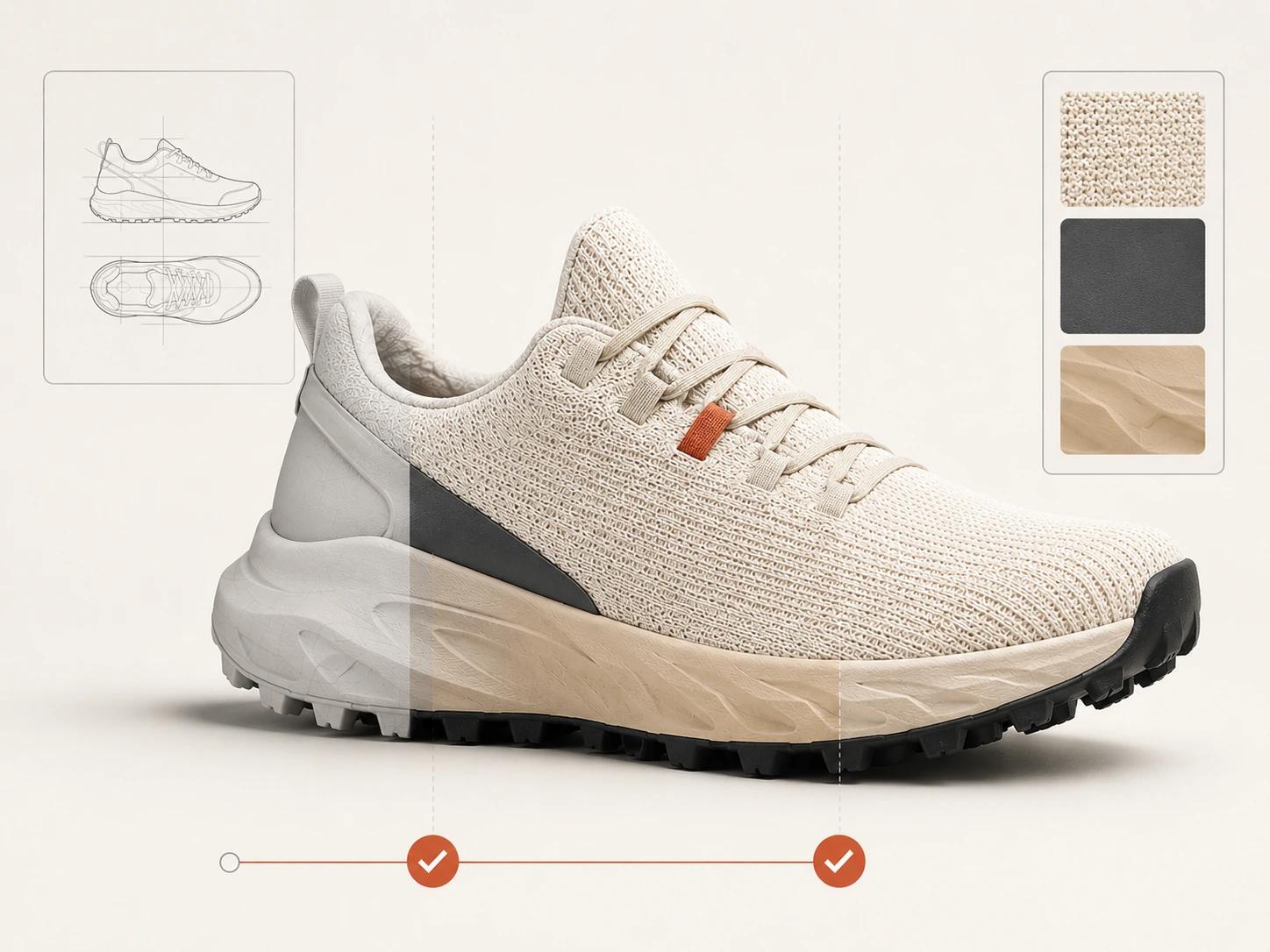
Ask for one redacted issue from detection through closure. The useful evidence is not a flawless first draft. It is a stable file ID, a marked location, the controlling product source, the correction, and a recorded approval.
Ownership and handoff
Separate five questions: who may use the final images, who owns or licenses the 3D work, which editable files are delivered, which third-party dependencies remain, and who is responsible for archiving or future changes. "Source files included" is too vague to answer any of them.
Khronos' current commerce guidance distinguishes native authoring files, which retain high editing flexibility, from glTF and USDZ delivery files intended for end-user real-time use.[3] A GLB can be a valid deliverable without being the editable master you expected. Ask for an inventory by filename class, software and version, texture sources, linked assets, required plug-ins, and known portability limits.
Copyright treatment depends on the agreement and governing law. As one jurisdiction-specific example, UK government guidance says the creator is normally the first owner of a commissioned copyright work unless ownership is otherwise agreed in writing.[5] Do not generalize that sentence into global legal advice. Have the relevant legal owner review assignment, licence, territory, duration, modification, sublicensing, portfolio use, third-party assets, and AI-related terms where they matter.
Revision mechanics
Ignore the headline number of rounds until the proposal defines a round. A workable change system separates four events:
- A correction brings work back to an already supplied and approved source.
- A clarification resolves a documented unknown.
- A direction change reopens an approved creative or product decision.
- A scope addition introduces a new output, view, product state, or variant.
Ask how comments are consolidated, when a round starts and closes, what happens to conflicting feedback, and how one change propagates across related shots or variants. The answer need not favor the buyer in every case. It needs to be legible enough that both sides can identify what changed and which work must reopen. An undefined "unlimited revisions" promise is weaker than a bounded process with a change record.
Scale and catalog operations
Catalog scale is an information problem as much as a rendering problem. Request a small, anonymized example showing stable product IDs, geometry families, finish variants, shot IDs, version states, and exceptions. Ask what is automated, what receives visual inspection, and where a human can stop a bad batch.
OpenUSD is one example of a system built for scalable interchange, asset composition, variants, and non-destructive overrides across applications.[6] A vendor does not need to use USD to score well. It does need an intelligible way to prevent a material update, geometry revision, or camera change from becoming a folder of untraceable copies.
Platform behavior can affect operations too. Shopify's current developer documentation treats files independently from products, processes them asynchronously, and allows one uploaded file ID to be referenced by multiple products or other resources.[7] That is specific to Shopify, but it illustrates the questions to ask: Who maps an asset to product records? Who waits for processing and verifies readiness? What happens when a shared file changes?
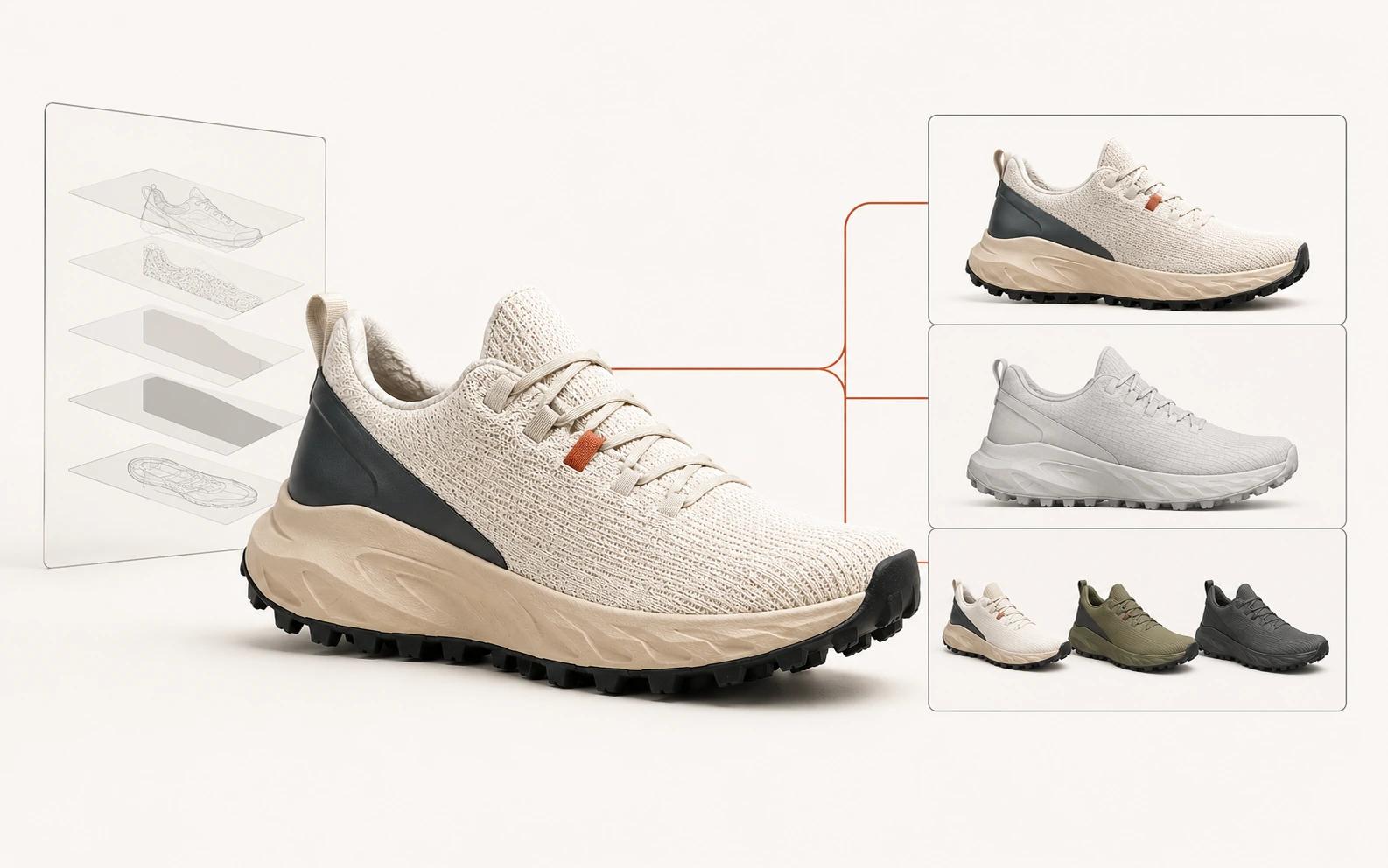
For a category with many materials and combinations, the furniture rendering guide shows why the variant and shot plan should be explicit rather than inferred from a single styled image.
Downstream reuse
State the next likely use even if it is outside the first scope. Future stills may need an editable scene and high-resolution textures. Animation may need separated parts, pivots, or rig-ready construction. A web viewer needs a runtime asset prepared for its actual publishing target.
Khronos' real-time guidelines require deliberate decisions about scale, origin, geometry, textures, materials, and optimization; for glTF commerce models, one unit is one meter and the model should represent the item at 1:1 scale.[2] Those requirements show why an offline render scene cannot simply be promised as web-ready. Conversely, a highly optimized delivery mesh may be awkward to revise as the product master.
Ask the vendor to draw the handoff: governed source, editable delivery where contracted, channel-specific exports, validation records, rights, and change owner. Shopify currently lists GLB and USDZ for its 3D product media and serves them for different delivery contexts.[7] Passing one platform's checks does not prove another destination, an animation workflow, or a configurator is ready.
Run a paid pilot when the risk justifies it
A pilot is useful when the contract is large, the product is difficult, or the evidence remains hard to compare. It should be paid, bounded, and representative rather than a request for speculative free work.
Choose one product that exposes the real challenge: mixed hard and soft materials, transparent parts, fine artwork, configurable pieces, or difficult source geometry. Do not choose the easiest SKU, and do not combine every catalog exception. Give shortlisted companies the same input pack, output specification, review window, and scorecard.
Require artifacts that reveal the workflow, not only a final beauty image:
- Input audit with assumptions, conflicts, and questions.
- Neutral geometry review and one material study.
- Representative final image at a named crop and color specification.
- Review log showing one correction or clarification.
- Proposed final-delivery inventory and rights/dependency statement.
- If reuse is in scope, one destination export plus its test record.
Score the pilot against the pre-agreed criteria. Record how many facts remained unresolved, but do not confuse a difficult source pack with poor vendor performance. A company that surfaces a real blocker may be safer than one that hides it behind polish.
Read the proposal and contract as one system
Before appointment, reconcile every attractive promise with a deliverable, owner, or acceptance test.
| Proposal phrase | Replace it with a checkable term |
|---|---|
| "Photoreal quality" | Named product-accuracy, material, composition, consistency, and technical acceptance checks |
| "Source files included" | File inventory, software/version, dependencies, editability limits, rights, and exclusions |
| "Catalog scale" | Product/variant map, capacity assumptions, exception path, QA sampling, and reconciliation method |
| "Fast revisions" | Feedback owner, review cadence, change classes, affected-file traceability, and approval record |
| "Ready for every channel" | Named destinations, separate exports where needed, and a test for each contracted destination |
Confirm commercial terms only after scope parity is clear. A lower quote may exclude modeling, retouching, project files, variants, implementation, or rights that another proposal includes. A higher quote may still carry assumptions that make it unsuitable. The scorecard does not choose the cheapest or largest company; it exposes what each offer actually contains.
Make the appointment on fit, not theatre
The best choice is the company whose evidence matches your product, outputs, risk, and operating model. Keep the raw scores, gate decisions, assumptions, sample files, and contract schedule together. That record will be more useful during production than the pitch deck.
If the scorecard shows that the brief itself is not ready, fix the product evidence and approval path before appointing anyone. If it produces a clear scope and you want to review a commercial production route, the 3D product rendering service is the relevant destination. The evaluation method still stands whether you choose that route, another studio, a freelancer, or an internal team.