
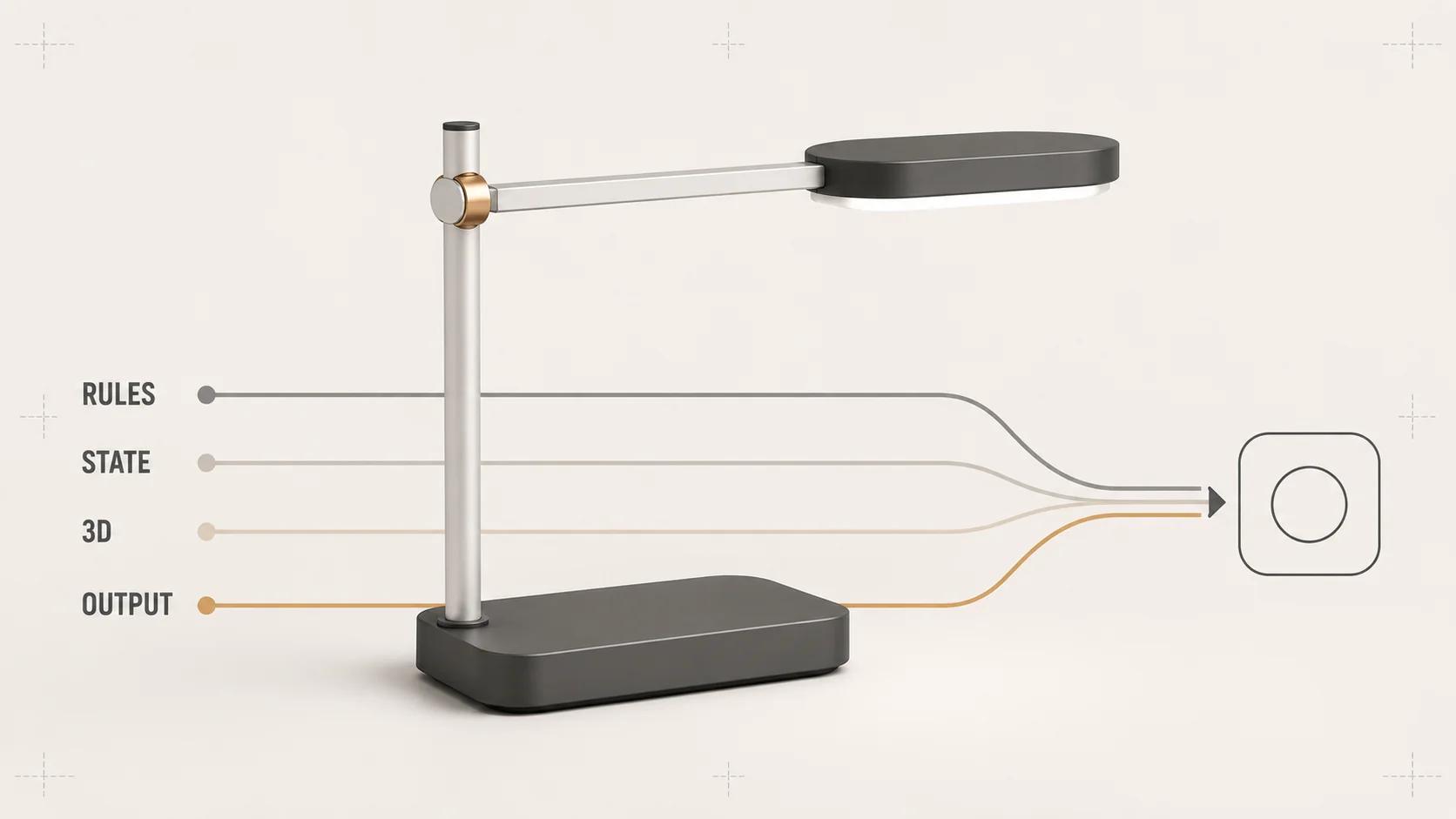
Build a 3D product configurator as a chain of explicit contracts, not as a 3D viewer with product options added later. Define one buyer or sales workflow, the valid product state, the owner of every rule, the required output and the release evidence first. Then prove that chain with one representative product before expanding the catalog.
A practical sequence is discovery, product logic, a vertical architecture slice, UX and content production, integrations, QA, then staged rollout. Each phase should end with evidence that the next team can inspect. A polished model cannot rescue incomplete rules, and a correct rules engine cannot compensate for an order payload that loses the selected configuration.
This article follows that implementation sequence. The 3D product configurator pillar guide gives the broader definition of rules, visuals and outputs. The build described here starts after a team has a plausible use case and needs to turn it into an accountable system.
Start with one release decision
The first release does not need to represent the entire catalog. It needs to prove one commercially meaningful path from an allowed selection to an accepted output. Choose a product family that exposes the hard parts of the project: at least one dependency, one visible change, one unavailable state and the real downstream action, whether that is add to cart, request a quote or produce an approved handoff.
Write the release decision in one sentence. For example: "A buyer can configure one modular task lamp, see every supported finish and component change, receive the authoritative price, and add a versioned configuration to the cart on the supported storefront." This is a planning example, not a claim about a completed implementation.
The sentence forces six early decisions:
- who the primary user is and where the experience runs;
- which product family and markets are in scope;
- which system owns options, compatibility, price and availability;
- what the 3D view must communicate and what a still image can cover;
- what the final transaction or document must contain; and
- what evidence an approver needs before release.
If two departments give different answers for a rule, the project is still in discovery. Do not hide that conflict in UI copy or ask an engineer to choose the business truth.
Separate product truth, experience state and rendered state
A configurator becomes easier to reason about when its architecture separates what can be sold from what the interface is currently showing. Product truth includes stable option IDs, dependencies, exclusions, dimensions, prices, availability and output mappings. Experience state includes the user's current selections, step, camera intent, open panel and recoverable errors. Rendered state is the resolved set of models, materials, transforms, labels and camera cues.
JSON Schema provides a vocabulary for making assertions about the shape of valid JSON documents, including required and dependent properties.[1] It is useful for the structure of a configuration payload. It is not a substitute for every engineering, commercial or manufacturing rule. Keep complex domain logic in a rule layer with named owners and executable examples.
glTF is an API-neutral runtime asset delivery format, and the specification deliberately does not mandate runtime behavior. It can represent scene nodes, transforms, meshes, materials, cameras and animations.[2] That makes it a useful visual delivery layer. It does not make node names or material slots the authoritative product catalog.
| Layer | What it owns | What it must not silently own |
|---|---|---|
| Product catalog | Stable product, option, component and market identifiers | UI order, camera behavior or renderer-specific names |
| Rule service | Defaults, dependencies, exclusions, calculations and valid transitions | Visual styling or a private copy of stale catalog data |
| Configuration state | Selected IDs, rule version, locale, currency and session status | Unvalidated price, inventory or manufacturing approval |
| Visual adapter | Mapping resolved product state to assets, materials, transforms and views | Commercial validity or checkout authorization |
| Experience layer | Controls, guidance, feedback, recovery and summaries | A second implementation of product rules |
| Integration layer | Price, availability, quote, cart, order and persistence contracts | Reconstructing choices from labels or screenshots |
| Operations layer | Publishing, permissions, versioning, monitoring and rollback | Unreviewed changes to live product logic |
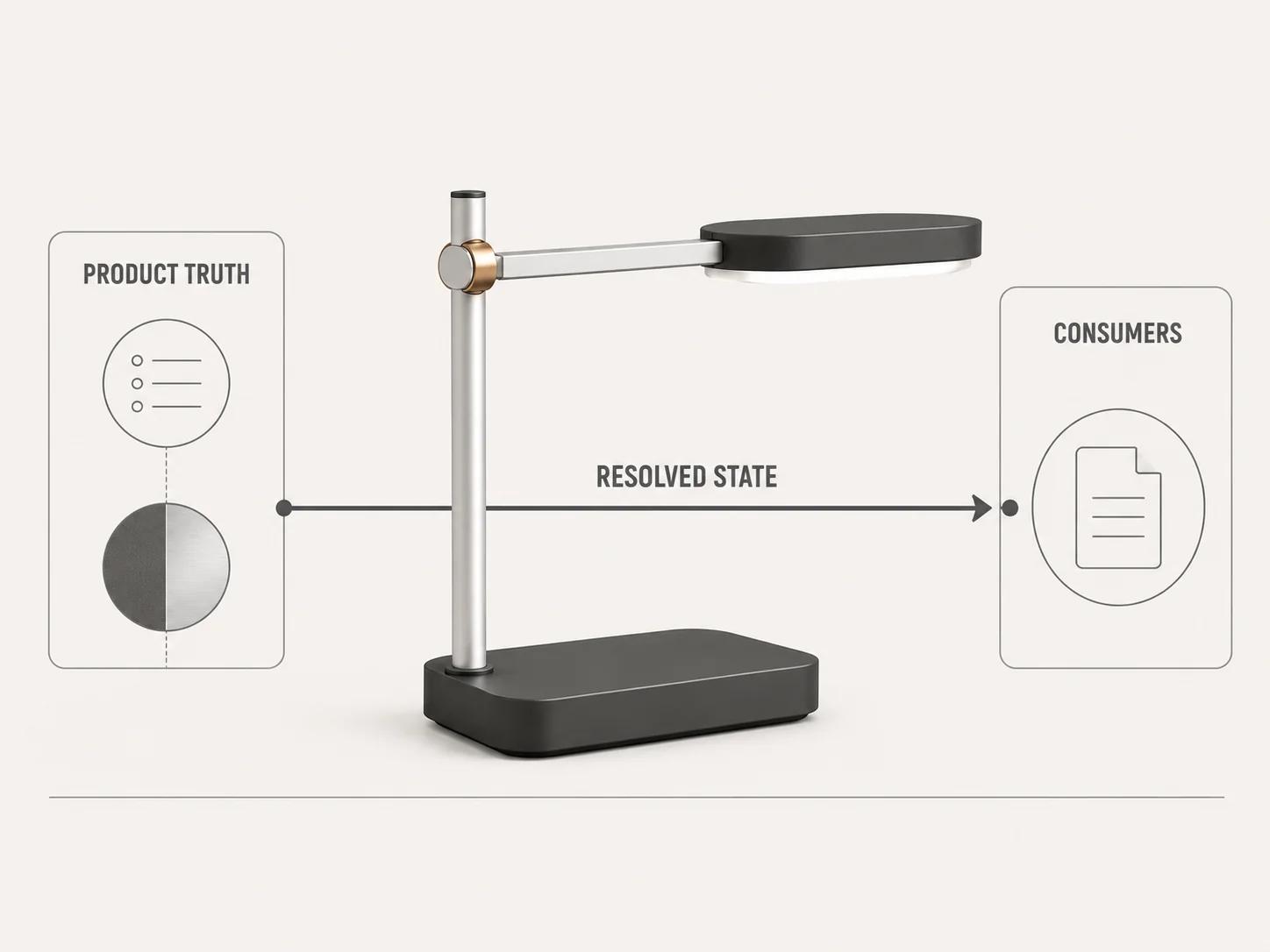
The useful design rule is one-way resolution. A user action proposes a candidate state. The rule layer resolves or rejects it. The experience and 3D view consume the resolved state. A transaction endpoint validates that state again against the authoritative rule and pricing versions. This keeps a quick client-side preview from becoming the source of truth for an order.
Give each saved configuration a stable reference plus the versions that produced it. At minimum, retain the product family, selected option IDs, rule-set version, asset-mapping version, market, currency, authoritative price response where applicable and creation time. If the product or price changes later, the team can explain whether to reopen, migrate or reject the saved state instead of guessing what the old labels meant.
Make integration behavior explicit before implementation
Treat every boundary as a contract. The OpenAPI Specification defines a language-agnostic description for HTTP APIs and a formal description of an API's surface and semantics.[3] A configurator integration contract should name request and response fields, identifiers, authentication, timeout behavior, retry policy, idempotency expectations, versioning and error states. A box labeled "ERP" on an architecture diagram is not enough.
Decide which side owns each calculation. The browser may predict a selection response for speed, but the server should independently validate any configuration that changes price, inventory, quote, cart or order data. OWASP's 2023 API Security Top 10 calls for object-level authorization checks when endpoints access data through user-supplied IDs and identifies unrestricted resource consumption and sensitive business-flow abuse as distinct risks.[4] Those risks apply to saved configurations, quote generation, pricing calls and cart actions even when the visible UI appears constrained.
For each integration, specify failure behavior before the happy path:
- Can the user continue if live price is unavailable?
- Is a displayed amount marked stale, hidden or replaced by "request a quote"?
- Does a cart action send a configuration ID, a full snapshot or both?
- What happens if a component becomes unavailable between save and checkout?
- Which system can reopen an old configuration, and under which rule version?
- Who can publish a product-rule change, and how is it rolled back?
Use contract fixtures built from real identifiers with sensitive values removed. Test a valid request, every expected rejection and a response that is late, incomplete or from an unsupported version. Integration completion means those behaviors are observed, not merely that one successful request reached a sandbox.
Size the architecture before the schedule
A calendar estimate made before product discovery usually measures confidence rather than scope. Capture the factors that change the system shape first. The following is a readiness conversation, not a score or a price calculator.
| Scope driver | Lower-complexity signal | Architecture consequence when it grows |
|---|---|---|
| Catalog | One family with shared option patterns | Templates, inheritance, migration and publishing governance become necessary |
| Rules | Independent choices with a few exclusions | Dependencies, formulas or engineered constraints need formal evaluation and broader test coverage |
| Visual content | Existing approved web assets | New modeling, material, naming, optimization and review pipelines join the software plan |
| Integrations | One documented commerce boundary | Multiple pricing, ERP, PIM, CRM or CPQ systems add orchestration, permissions and failure states |
| Outputs | A screen summary and cart reference | Quotes, bills of materials or manufacturing data require traceability and approval rules |
| Operating model | One product owner and one market | Regions, teams and roles require workflow, localization, audit and release controls |
The Custom Configurator Scope and Budget Estimator turns visitor-supplied scope drivers into an explainable complexity profile and recommended path. It does not provide a project quote; pricing still depends on validated rules, assets, integrations, ownership and acceptance criteria.
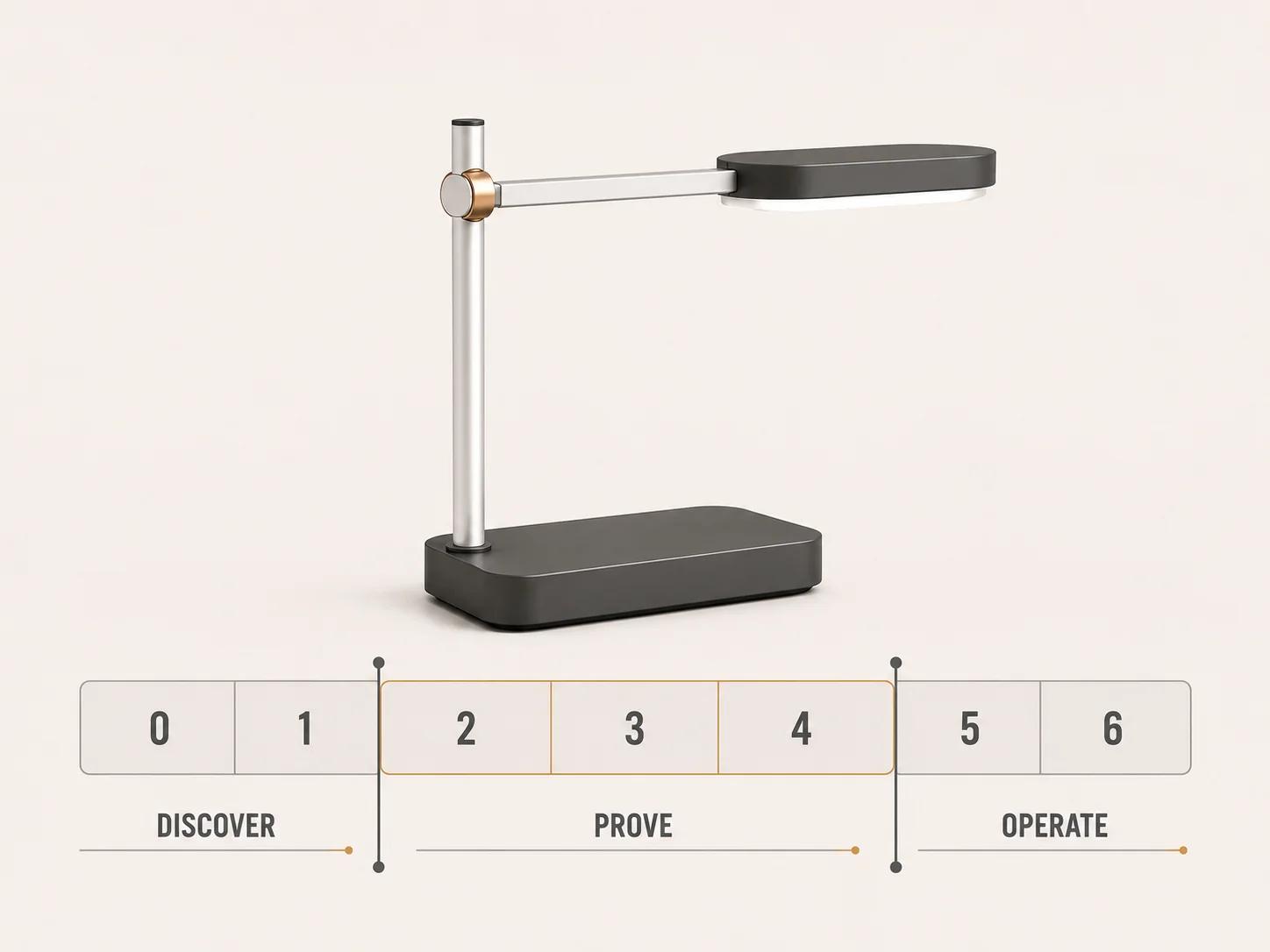
Use a seven-phase implementation roadmap
The roadmap below is an original Double Edged delivery framework. Phases can overlap, but their exit gates should not disappear. Overlap is useful when it shortens feedback; it is dangerous when unfinished product decisions get treated as approved inputs.
| Phase | Main work | Required exit evidence |
|---|---|---|
| 0. Discovery and boundary | User, destination, product family, output, owners, constraints and exclusions | Signed scope boundary, responsibility map and representative product choice |
| 1. Product logic and content | IDs, options, defaults, dependencies, copy, price and output mappings | Versioned rule model, conflict log, examples and owner approval |
| 2. Architecture and vertical slice | State contract, rule resolution, visual mapping, one real integration seam | One end-to-end path with recorded decisions and known limitations |
| 3. UX and asset production | Flow, controls, recovery, mobile behavior, models, materials and fallbacks | Approved interaction prototype plus asset acceptance records |
| 4. Integrations and administration | Pricing, cart or quote, save/share, publishing, roles and observability | Contract tests, permission tests, operational workflow and rollback proof |
| 5. QA and controlled pilot | Rule, visual, UX, device, performance, security and output testing | Evidence matrix, resolved blockers, accepted exceptions and release decision |
| 6. Staged rollout and operation | Limited release, monitoring, support, change control and expansion | Named owner, live checks, rollback trigger and next-family decision |
Phase 0: discovery and boundary
Interview the people who define, sell, produce, price, support and update the product. Ask them to configure the representative product with current source material in front of them. Record disagreements as unresolved decisions. A spreadsheet is evidence of today's practice, not automatic proof that every row is current or consistent.
Document what the first release will not do. Exclusions might include dealer pricing, manufacturing output, AR, a second market or older saved configurations. An exclusion is useful only when the user flow and data contract handle it honestly. If a future requirement would change the core state model, capture it as an architecture constraint even if its UI is deferred.
Phase 1: product logic and content
Replace display labels with stable identifiers. Model options, defaults, required choices, compatibility, conditional visibility, calculated values and invalid states. Add a plain-language explanation and an owner to each rule family. Pair rules with positive and negative examples that can become automated tests.
Content belongs in this phase because guidance changes how people complete a configuration. Define option names, descriptions, units, warnings, unavailable-state copy, summaries and fallback imagery alongside the rule model. Keep translatable text separate from IDs. Decide whether a rule disables an option, hides it, changes a default or asks the user to repair a previous selection; those behaviors are different product decisions.
Phase 2: architecture and a vertical slice
Build the thinnest path that crosses every risky boundary. Use the real rule representation, one representative optimized asset, the intended runtime, one price or availability seam and the actual transaction shape. Avoid a throwaway demo whose hard parts are replaced with constants; it can validate presentation while leaving the architecture untested.
The slice should expose where product state lives, how changes resolve, how the renderer receives them, how failures return to the UI and what survives into the downstream output. Record request samples, state transitions, asset versions, device profile and known gaps. The goal is evidence about feasibility and ownership, not a visually complete launch candidate.
Phase 3: UX and asset production
Design controls against the real rule states. A disabled finish needs a reason. An automatic dependency change needs visible feedback. A reset needs a defined scope. A mobile layout needs a way to preserve product context while controls occupy limited space. The 15 configurator UX patterns guide owns the deeper pattern audit rather than turning this build roadmap into a duplicate UX article.
WCAG 2.2 requires content functionality to be operable through a keyboard interface, subject to its path-dependent exception, and requires automatically detected input errors to be identified and described in text.[5] Test the controls, summary and recovery path without relying on pointer gestures or a color change in the 3D scene.
Run asset production against an asset specification: scale, orientation, pivots, named parts, material zones, texture policy, visual reference views, budgets and fallback media. Test the asset in the target runtime. A file that passes structural validation may still map the wrong finish, hide a required component or render an unacceptable product state.
Phase 4: integrations and administration
Connect authoritative price, availability, save/share, quote, cart or order behavior according to the contracts defined earlier. Preserve a versioned configuration reference in every downstream handoff. If a human must review an output, represent that state instead of labeling it complete.
Build administration with the same care as the buyer flow. Product teams need preview, validation, approval, scheduled or controlled release, audit history and rollback. Restrict sensitive operations by role. A content editor should not gain permission to alter executable pricing logic merely because both values appear in one admin screen.
Phase 5: QA and a controlled pilot
Test rules from the model, not by clicking whatever paths occur to the team. Generate cases for defaults, dependencies, exclusions, boundaries and previously failed combinations. Compare the resolved configuration, visible summary, 3D state, authoritative price and downstream payload for the same case ID.
Use named browsers, physical devices where they matter, network conditions, product references and test data. Separate defects from accepted exceptions. A pilot should limit exposure by product, audience or market and include support and rollback owners. It does not convert untested catalog families into approved ones.
Phase 6: staged rollout and operation
Release only the product families covered by the evidence. Monitor errors, unresolved configurations, integration failures, asset delivery and support cases. Review field behavior before expanding. Product launches, rule changes, price-source changes, runtime upgrades and new integrations should reopen the affected tests.
Treat the configurator as an operated product. Assign owners for product data, rules, 3D assets, UX, software, integrations, analytics and support. Define service expectations and a rollback trigger. Expansion is a new scoped decision, not a copy-and-paste task.
Keep UX, rules and 3D on one resolved state
A common failure mode is three representations drifting apart: selected controls say one thing, the 3D view shows another and the cart receives a third. Prevent that by letting all three consume a resolved configuration object with stable IDs. Labels and material names are presentation; they should not be used to reconstruct the order.
Define each transition as input, resolution and effects. If selecting a long arm removes an incompatible base, the rule result should name the accepted selection, removed selection and reason. The UI can then explain the change, the renderer can update the correct parts and analytics can record a typed event without copying the rule.
For expensive calculations, profiling may justify moving work away from the main UI thread. MDN documents that Web Workers run scripts in a background thread, cannot directly manipulate the DOM and exchange copied messages with the main thread.[6] A worker is an implementation option, not a default architecture requirement. First measure whether rule evaluation, geometry work or data transformation is blocking interaction, then isolate work with a defined message contract.
Test linked contracts, not isolated features
One green test suite cannot approve the whole system. Use a release matrix that follows representative configurations across the rule, visual, UX and transaction layers.
| Test surface | Representative assertion | Evidence to retain | Blocking example |
|---|---|---|---|
| Product rules | Every resolved combination satisfies the approved rule version | Case ID, input, resolved state, explanation and rule version | An excluded pair reaches review |
| Visual mapping | Resolved IDs produce the approved components, materials and transforms | Asset version, reference views and captured comparison | Summary says amber while the product remains graphite |
| UX and accessibility | Controls, feedback, summary and repair path work with supported input modes | Browser, device, keyboard script and observed result | A required choice can be completed only by dragging |
| Integration | Authoritative price and downstream payload match the resolved state | Redacted request, response, config reference and system versions | Cart line loses the component selection |
| Performance | Loading and interaction remain within the project's named lab and field budgets | Build, device, network, repeated lab runs and field segment | Rule or render work blocks supported interactions |
| Security and permissions | Saved states and privileged changes enforce ownership and role boundaries | Test identity, operation, expected denial and audit event | One user can fetch another user's saved configuration |
| Operations | A rule or asset release can be previewed, approved, observed and rolled back | Revision, approver, release event, health checks and rollback record | A bad rule has no recoverable prior version |
Google's Web Vitals guidance currently defines LCP, INP and CLS around loading, interactivity and visual stability. It also distinguishes development-time lab measurement from field data and says lab measurement is not a substitute for field measurement.[7] Use both where the release has enough real traffic, and keep configurator-specific measures such as asset-ready time, rule-resolution time and transaction errors beside page-level metrics. The real-time 3D configurator guide owns the detailed rendering and performance trade-offs.
Do not average away a failed device, product family or rule path. Report the test profile and the affected segment. A median can describe repeated runs within one profile; it cannot prove coverage of devices or catalogs that were never tested.
Prepare the operating handoff before launch
A build-ready handoff should contain more than source code. Include the product and rule dictionaries, state and API contracts, asset specification, content model, test cases, supported environments, permissions, release process, monitoring, exception register and ownership map. Keep a decision log for trade-offs that would otherwise be rediscovered after staff or vendors change.
Spellexo can be referenced as an owned Double Edged proof point for product strategy, UX, 3D production, engineering, testing, launch and ongoing operation. The Spellexo case study does not prove rescue, migration or a client's commercial outcome, and this build roadmap does not use it that way.
Before rollout, confirm these questions have named answers:
- Which repository or system is authoritative for each rule and asset mapping?
- Who approves a product change, and what evidence do they see?
- How are old saved configurations reopened after a rule or price change?
- What happens when the renderer, price service or cart endpoint is unavailable?
- Which device, browser, network and assistive-technology profiles are supported?
- Which metrics and error classes trigger investigation or rollback?
- Who owns the first support response and the final product decision?
If those answers are missing, the remaining work is not merely launch polish. It is part of the architecture.
Choose the next step from the unresolved risk
A focused product with simple rules and one clean integration may be ready for a platform-fit test. Dependent products, incomplete assets, dynamic pricing, multiple systems or governed outputs usually need a phased MVP or paid discovery before a delivery estimate is trustworthy. Use the unresolved evidence to choose the path rather than forcing every project into the same stack.
When the remaining gap requires product-specific architecture, UX, 3D production and integration delivery, the custom 3D product configurator service is the commercial route. The article remains the build guide; the service page owns direct hiring intent.



