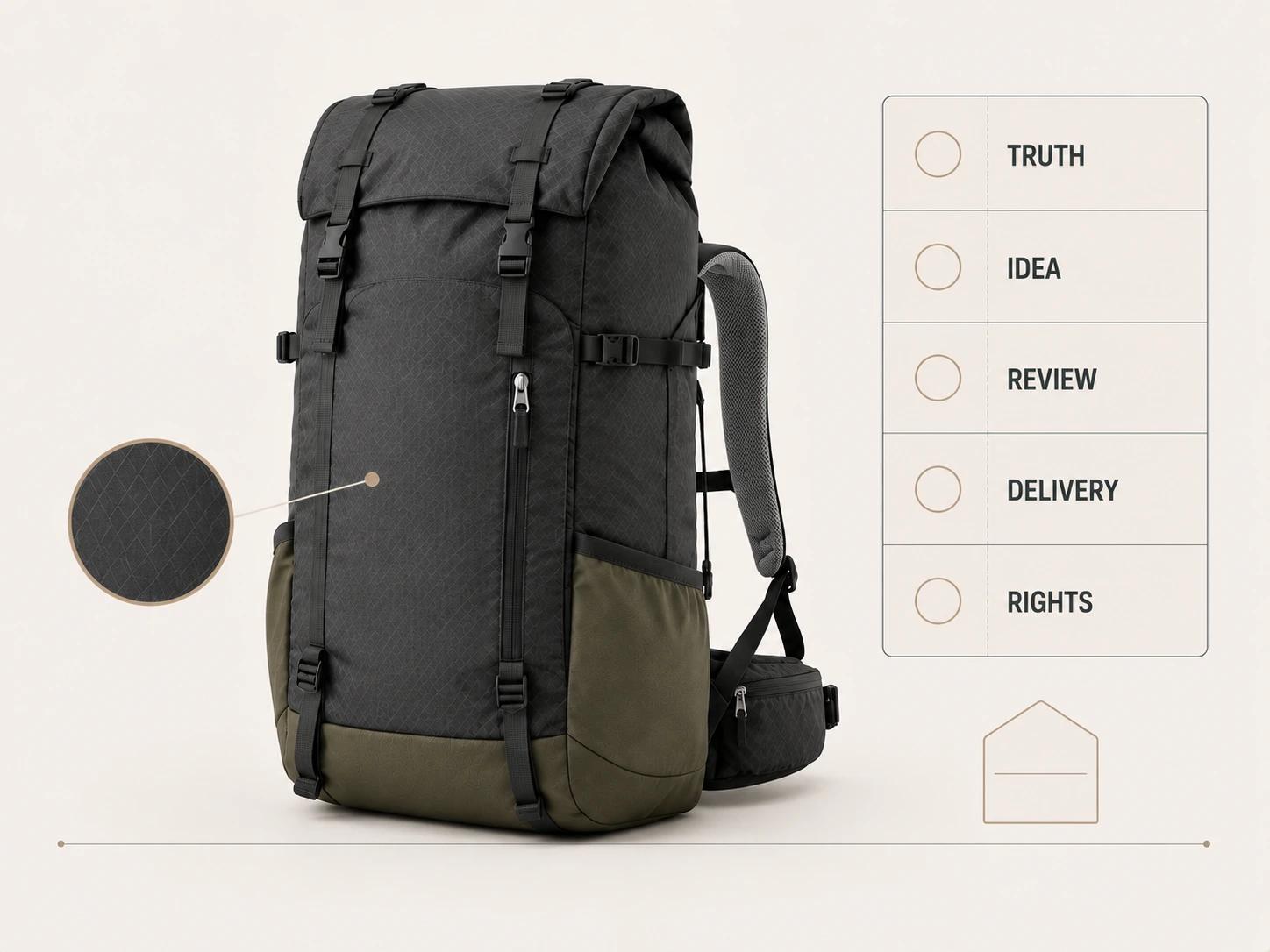
A strong 3D product animation studio selection starts before the portfolio call. Give every candidate the same product evidence, communication problem, destinations, deliverables and review rules. Then score each response against evidence you can inspect: how the studio protects product truth, turns the brief into a visual idea, manages approvals, prepares outputs and defines rights.
A showreel can prove that a team has made polished work. It cannot, by itself, tell you who modeled the product, whether the product shown was accurate, how the team handled revisions, what the client received or whether the work resembles your constraints. Use the reel to decide what to investigate, not to award the project.
This guide owns that buyer-side decision: the brief, response format, evaluation rubric and ownership checklist. For the broader choice between feature films, explainers, loops and other formats, start with 3D Product Animation: Formats and Use Cases Across the Funnel. For the production sequence after appointment, use 3D Animation Video Production: A Client's Stage-by-Stage Guide.
Define the purchase before you compare studios
Write one sentence that connects the viewer, the required understanding and the action the animation should support. For example: "Help a first-time buyer understand how the suspension system adjusts before they compare variants on the product page." That is more useful than "create a premium launch film" because it gives the studio a communication problem to solve.
Name the decision owner too. A marketing lead may own the story while an engineer owns assembly accuracy and a brand lead owns visual treatment. If nobody can resolve a conflict between those views, the studio cannot make a reliable approval plan.
Keep adjacent questions in their proper place. Supply a real budget boundary and immovable launch constraint if they exist, but use the separate cost guide to examine cost drivers rather than turning this vendor rubric into a pricing table. Likewise, do not ask a proposal to reproduce every production stage. Ask candidates to show how their proposed process controls the risks in your brief.
Copy this animation studio brief template
A brief and a contract do different jobs. The brief defines the problem and acceptance evidence. The contract turns the agreed scope, responsibilities, rights and change rules into binding terms. AIGA's modular agreement follows the same separation: a custom proposal covers objectives, process, milestones and delivery, while basic terms, intellectual-property provisions and a motion-specific supplement address the legal relationship.[1]
| Brief section | What the buyer supplies | What the studio must return |
|---|---|---|
| Outcome and audience | Viewer, decision to support, single main message, approved claims and success evidence | A plain-language interpretation of the communication problem |
| Destinations | Named product page, sales presentation, event screen, marketplace, social or training context | Output matrix with aspect ratio, resolution, frame rate, duration, audio, caption and crop assumptions per destination |
| Product truth | CAD or models, drawings, dimensions, reference photos, material and finish data, labels, packaging, variant list and known gaps | Input audit that separates usable evidence, reconstruction work, assumptions and blocked decisions |
| Action and shots | Required feature, mechanism or assembly steps; unsafe, confidential or misleading views to avoid | Proposed visual sequence showing what each shot proves and which source controls it |
| Creative constraints | Brand system, tone, approved references, forbidden treatments, on-screen copy and legal text | Direction rationale that explains why the treatment helps the viewer understand the product |
| Review and governance | Named product, creative and release approvers; consolidated feedback owner | Review states, version IDs, comment method, approval records and change-control rule |
| Deliverables | Required masters, derivatives, stills, captions, audio stems, editable or runtime assets | Exact file list, format specifications, dependencies, validation method and handover structure |
| Rights and confidentiality | Intended media, territories, term, exclusivity, portfolio restrictions and sensitive inputs | Rights schedule covering final work, working files, third-party material, subcontractors and retained tools |
Do not fill uncertain cells with guesses. Label each as confirmed, buyer to supply, studio to investigate or excluded. That distinction lets candidates price and plan the same problem instead of quietly making different assumptions.
The destination row deserves particular care. "Social cutdowns" is not a specification. YouTube's current guidance, for one destination, names container, codecs, frame rate behavior, aspect-ratio handling and SDR color space.[3] Other destinations can differ, so record a dated source or a buyer-approved delivery profile for each output. If the animation will be published on a site targeting WCAG 2.2, include accessibility in scope: WCAG 2.2 calls for captions for prerecorded audio in synchronized media at Level A and audio description for prerecorded synchronized video at Level AA.[2] Those requirements affect script, edit and delivery planning; they are not a last-minute export checkbox.
Build a product evidence pack
Candidates need enough evidence to identify uncertainty. A useful pack contains the controlling product files, a read-me that explains each file, and a gap register. Include only materials you are authorized to share, through the agreed secure route.
For each visible fact, name the controlling source. A dimension may come from released CAD; a fabric color may come from an approved swatch; a screen state may come from signed interface artwork. If sources disagree, name the person who decides. Ask the studio to keep an assumption log and show assumptions in review renders before they become expensive-looking facts.
Separate geometry variants from finish variants. A new buckle, port, control or attachment can require different modeling and animation, even when the sales catalog calls it another color. For machinery, the safety and installation review belongs in the dedicated machine installation animation planning guide; this selection brief only asks whether the studio has a credible method for controlled technical review.
Send one response request to every candidate
Comparable proposals need a common response shape. Ask each studio to return:
- its reading of the audience, message and hardest project risk;
- an input audit with assumptions, exclusions and buyer dependencies;
- a proposed visual approach tied to the required product claims;
- the named roles that will perform and supervise the work;
- a deliverable and rights schedule;
- a review, change and acceptance plan; and
- two or three relevant work examples with the studio's actual contribution identified.
Allow questions, then issue the same material clarification to every candidate still under consideration. Do not reward a studio for guessing around missing information that another studio responsibly flagged.
A relevant example is close in risk, not merely in style. For a translucent product, material and internal-geometry control may matter. For a mechanism, sequence accuracy may matter. Ask what source material existed, what the studio built, which parts were subcontracted, what the client approved and which deliverables were included. Respect confidentiality; a candidate should be able to explain its method without disclosing another client's protected files.
Score evidence with a weighted rubric
The table below is an original Double Edged editorial framework, not a universal procurement standard. Adjust the weights before opening proposals, apply them consistently, and set must-pass conditions for product truth, rights and security. Score each criterion from 0 to 5, multiply by its weight, then divide by 5. A polished reel must not rescue a zero on a must-pass gate.
| Criterion | Weight | Evidence for a high score | Evidence for a low score |
|---|---|---|---|
| Product truth and input handling | 25 | Audits source assets, identifies gaps, names controlling evidence and records assumptions | Treats references as inspiration, hides reconstruction or cannot explain accuracy approval |
| Communication and creative fit | 20 | Connects every major shot to the audience's question and an approved product claim | Offers a generic visual style with no reason for the sequence |
| Review and delivery control | 20 | Uses named reviewers, version IDs, consolidated comments, acceptance checks and change rules | Relies on informal comments, vague revision rounds or an undefined "final" file |
| Technical reuse and accessibility | 20 | Specifies masters and derivatives, caption or audio-description needs, source/runtime assets and validation | Promises one high-resolution file for every destination or leaves dependencies unstated |
| Rights and commercial clarity | 15 | Separates final work, working files, third-party material, retained tools, subcontractor rights and portfolio use | Uses "full ownership" without defining files, rights, conditions or exclusions |
Write one evidence note beside every score. "Good process" is not evidence; "the proposal names the product approver, review file ID and acceptance record" is. Hold the scorecard until reference checks and clarification calls are complete. Chemistry matters, but it should explain a close decision rather than erase a material gap.
Use the interview to test the proposal
A structured interview reveals whether the written response belongs to the team you will work with. Include the proposed producer and a senior 3D lead, not only sales. Give every shortlisted studio the same core questions:
- Which product fact in our pack is least certain, and how would you resolve it?
- Walk us from one approved claim to the shot, review evidence and final derivative that carries it.
- What change would reopen product approval rather than count as a normal creative refinement?
- Show how a reviewer can identify the exact file, frame and decision under discussion.
- Which deliverables can we modify later, with what software, plug-ins, linked assets and licenses?
- What is excluded, retained or supplied by a third party?
- Who performs modeling, simulation, lighting, compositing, sound and final quality control?
If a remaining technical risk cannot be tested through prior evidence, define a small paid proof with its own inputs, acceptance condition and rights. Do not solicit free speculative production or mistake a pretty test frame for evidence that the full governance plan works.
Review work in three passes
Once a studio is appointed, keep evaluation criteria alive as acceptance gates without duplicating the full stage-by-stage production guide.
First, review product truth. Check geometry, mechanism states, materials, artwork, labels, variants and the sequence of any claimed action against controlling sources. Record the decision and unresolved assumptions. A creative approval should not override a product rejection.
Second, review communication. Watch once without pausing, then inspect the moments carrying the main claim. Can the intended viewer identify the product, understand the action and read necessary copy at the expected size? Check framing, hierarchy, pacing, continuity and audio against the brief, not against a late preference that was never scoped.
Third, review delivery. Inspect the actual encoded masters and derivatives, captions, audio, stills and manifests. Adobe's current Media Encoder documentation illustrates why this is a separate check: its source/output comparison can expose crop, scaling, rotation, color and quality changes introduced by export settings.[6] Open representative files in their intended destination where access permits. An approved working preview does not prove that every derivative is complete or correctly framed.
Put ownership and handover in writing
"We own everything" is too vague to operate. List the final rendered works, editable project files, models, textures, simulations or caches, linked fonts, audio, plug-ins, third-party stock, runtime exports, documentation and archive period. State which items transfer, which are licensed, which remain studio tools, when rights take effect and whether the studio may show the work.
Do not treat a web-ready model as an editable source package. Khronos defines glTF as a format for efficient transmission and loading of 3D scenes and models; a GLB can package scenes, meshes, materials, textures, skins and animations.[4] That makes GLB useful as a named runtime deliverable, but it does not tell you whether native authoring files, procedural setups, high-resolution textures or simulation sources are included.
Copyright rules depend on jurisdiction, so use qualified legal counsel for the agreement. In the United States, ownership of a material object is distinct from copyright ownership, and a copyright transfer generally must be in writing and signed by the rights owner or authorized agent.[5] A payment, downloaded file or delivered drive is not a substitute for a precise rights clause. AIGA's agreement likewise separates final works, preliminary works, working files, designer tools and third-party materials rather than assuming one phrase covers them all.[1]
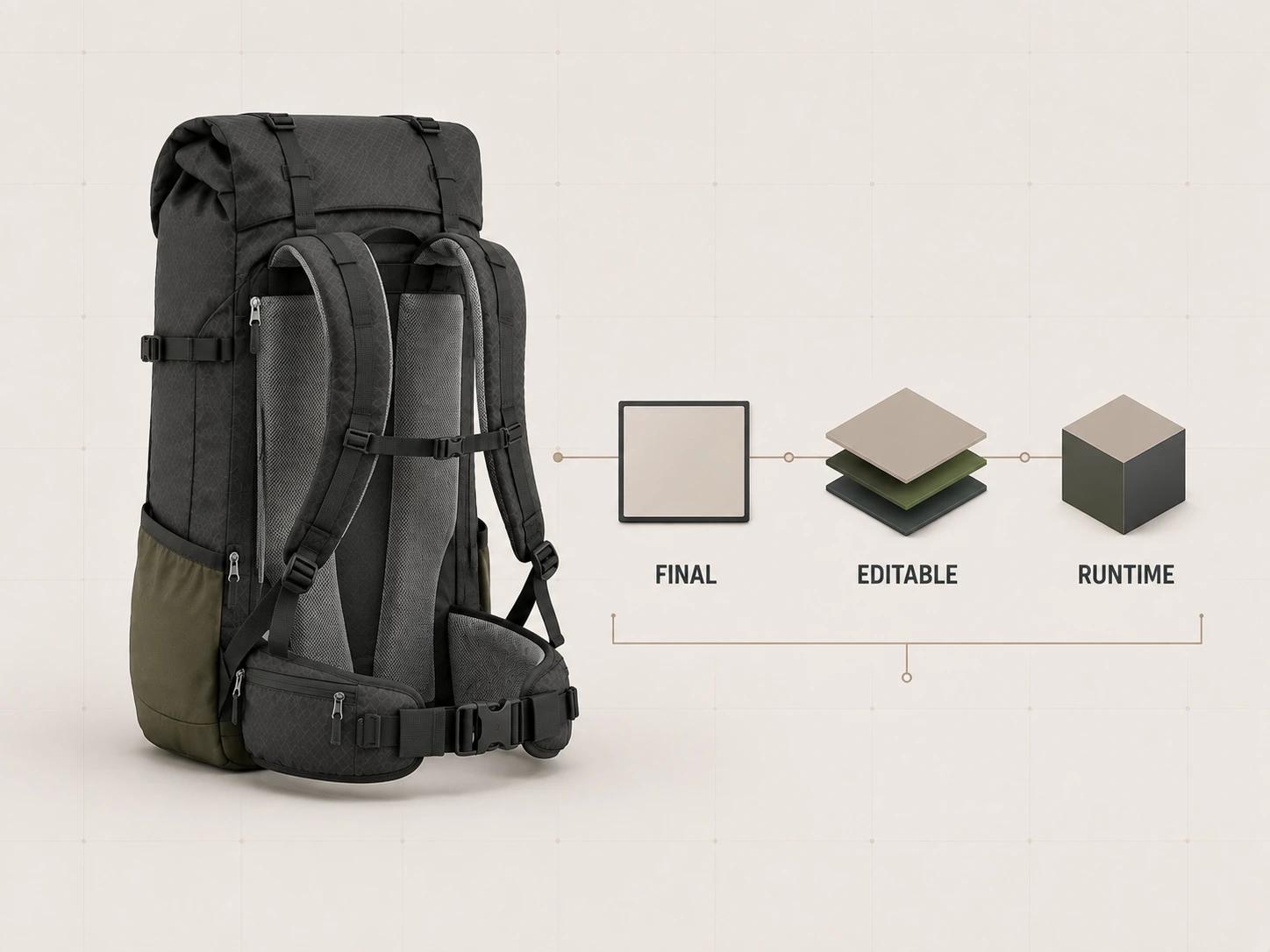
Attach an asset register at handover. For every item, record its filename, version, format, owner or licensor, permitted use, dependency and storage location. Test the package with the people expected to reuse it. If they cannot open, relink or understand a promised editable deliverable under the agreed conditions, the handover has not passed.
Final selection checklist
- [ ] Every candidate received the same current brief and clarification set.
- [ ] The brief names one audience decision, approved claims and controlling product evidence.
- [ ] Destinations and deliverables are explicit; "social," "4K" and "source files" are not left undefined.
- [ ] Product, creative and release decisions have named owners.
- [ ] Assumptions, exclusions, buyer dependencies and confidential inputs are visible.
- [ ] Work examples identify the candidate's actual role and the relevant project risk.
- [ ] Scores cite proposal, interview or reference evidence and use weights fixed in advance.
- [ ] Product truth, rights and security are must-pass gates.
- [ ] The review plan uses stable file and version identities plus consolidated feedback.
- [ ] Final encoded derivatives have their own acceptance checks.
- [ ] Accessibility outputs are scoped for the intended destination and policy.
- [ ] The agreement separates final works, working files, runtime exports, retained tools and third-party materials.
- [ ] The handover register names dependencies, licenses and reuse conditions.
A studio should leave you with fewer hidden decisions, not a longer list of promises. The best-supported proposal is the one that can explain what will be true, who will approve it and what evidence will remain after delivery.
Bring a decision-ready brief
Share the product, intended outputs, available source assets, launch constraint and named reviewers. That gives a producer enough context to identify gaps and discuss a responsible scope without inventing proof, price or delivery promises.