
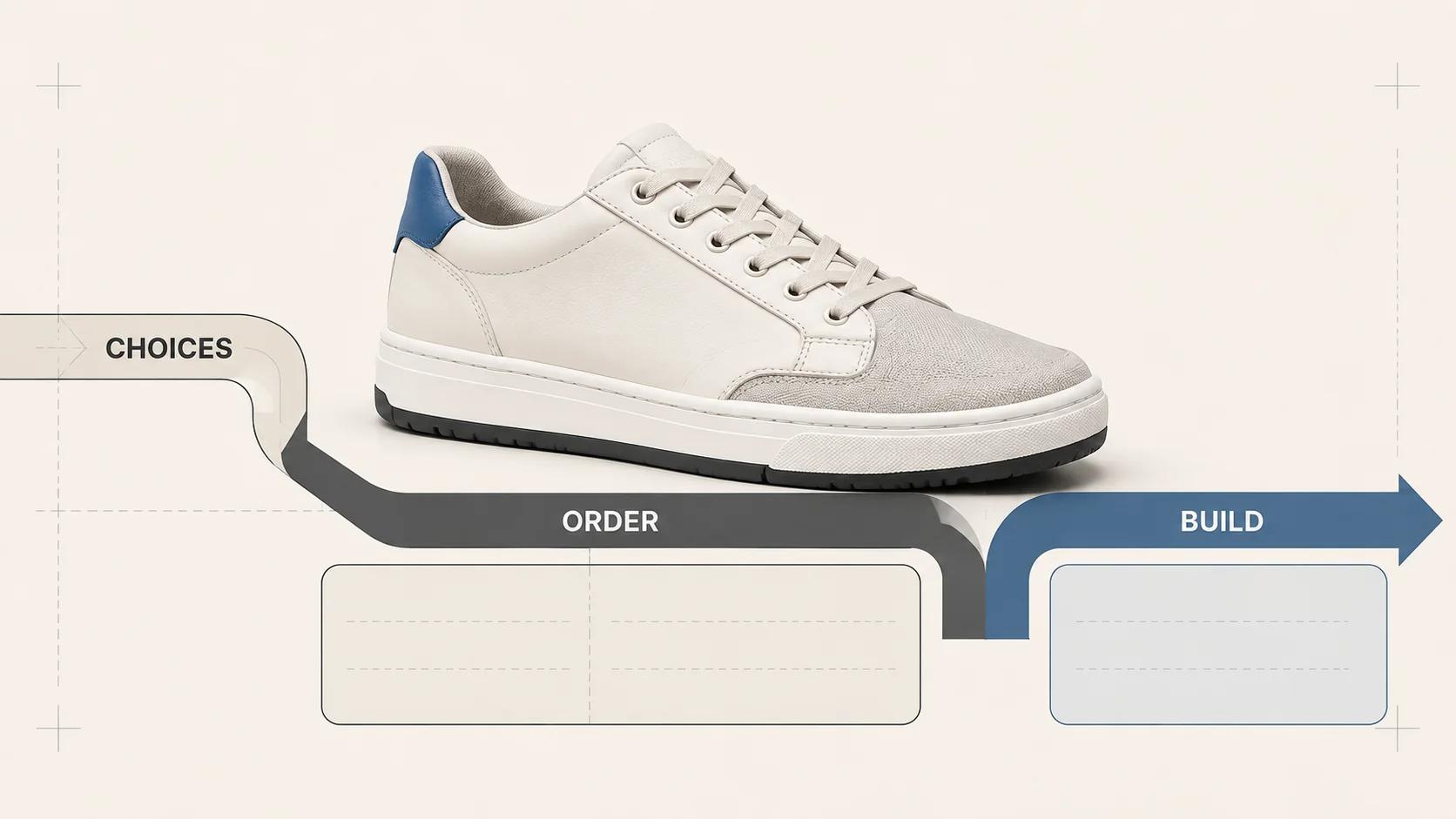
A useful 3D shoe configurator is a controlled product system with a visual front end. It must connect every visible choice to a valid option, price and order record, then carry the approved choices into production without asking a factory to interpret a screenshot. A realistic shoe that cannot be ordered is a demo. An order that loses its material codes, size basis or personalization coordinates is a production risk.
The practical unit is a versioned configuration identity. It should resolve the base style, size and width, colorway or panel selections, personalization parameters, market, price version, rule version and 3D asset version. The browser renders that state, but it should not become the only place where the state exists.
This article covers the footwear layer: panels, materials, graphics, sizing, personalization, camera evidence, pricing and manufacturing outputs. The broader rules-to-quote-to-BOM model belongs in the 3D product configurator for manufacturing. If the product instead depends on metals, stones, ring sizing, engraving and AR, use the 3D jewelry configurator playbook.
Start with one configuration identity
Write the state schema before designing swatches. A workable footwear identity might read:
style=runner-01 | size=EU-42 | width=standard | upper=stone | quarter=cobalt | laces=stone | sole=charcoal | heel_text=ADEL
The production record needs stable IDs behind those labels. cobalt might be friendly storefront copy, while the order carries a controlled material-color code, supplier code or approved swatch revision. Keep both. Human-readable labels help the shopper and support team; durable IDs let integrations survive a copy change.
Do not flatten everything into one SKU too early. A sellable colorway may have a SKU and stock position. A made-to-order panel combination may instead be a rule-valid configuration that generates an order line and production package. Personalization is usually an order-specific parameter, not a reusable catalog variant. These classes can share one interface, but they need different downstream treatment.
Persist at least the selected IDs, display labels, resolved dependencies, price result, currency, rule-set version, asset version and a deterministic configuration hash. Keep a proof image as supporting evidence, not as the source of truth. The same saved record should restore the visual state and reproduce the output package after a browser refresh or support handoff.
Model the shoe as controlled zones
A footwear model needs semantic zones that match real option ownership. Do not rely on mesh names such as Object.017. Use stable concepts such as vamp, toe cap, quarter, eyestay, tongue, laces, lining, heel tab, midsole and outsole. A zone can own one material assignment, a graphic surface, a visibility switch or a constrained personalization area.
Nike's Nike By You page, checked on 31 August 2026, is a useful public example of the option types, not a template for another brand's rules. It described curated color palettes, material options and an alphanumeric personal ID in its own builder.[2] The lesson is that "color" is rarely one global property. The selectable surface, material family and decoration method all matter.
Khronos' ratified KHR_materials_variants extension can represent finite, premade, holistic material variants and switch them at runtime. Its own design notes say complex configuration authorship and application-specific business logic are outside that extension's goal.[1] Use a material-variant feature where it fits, but keep compatibility, price and manufacturing rules in an explicit application layer.
| Shoe zone | Customer-facing decision | 3D responsibility | Production key |
|---|---|---|---|
| Vamp and toe | Material, color, perforation treatment | Correct surface response, seams and normal detail | Panel ID, material code, color code, finish |
| Quarter and overlays | Color blocking, material family, graphic eligibility | Stable masks or separate geometry with clean boundaries | Pattern-piece ID, approved combination, print zone |
| Eyestay and laces | Lace color, eyelet finish, closure option | Distinct parts with rule-driven visibility and material | Trim codes, length, hardware finish |
| Tongue, lining and heel tab | Lining color, label treatment, personal ID | Legible close view and constrained text surface | Component code, decoration method, safe area |
| Midsole and outsole | Compound color and compatible sole unit | Accurate silhouette and clear sole view | Tooling or sole-unit ID, compound, size range |
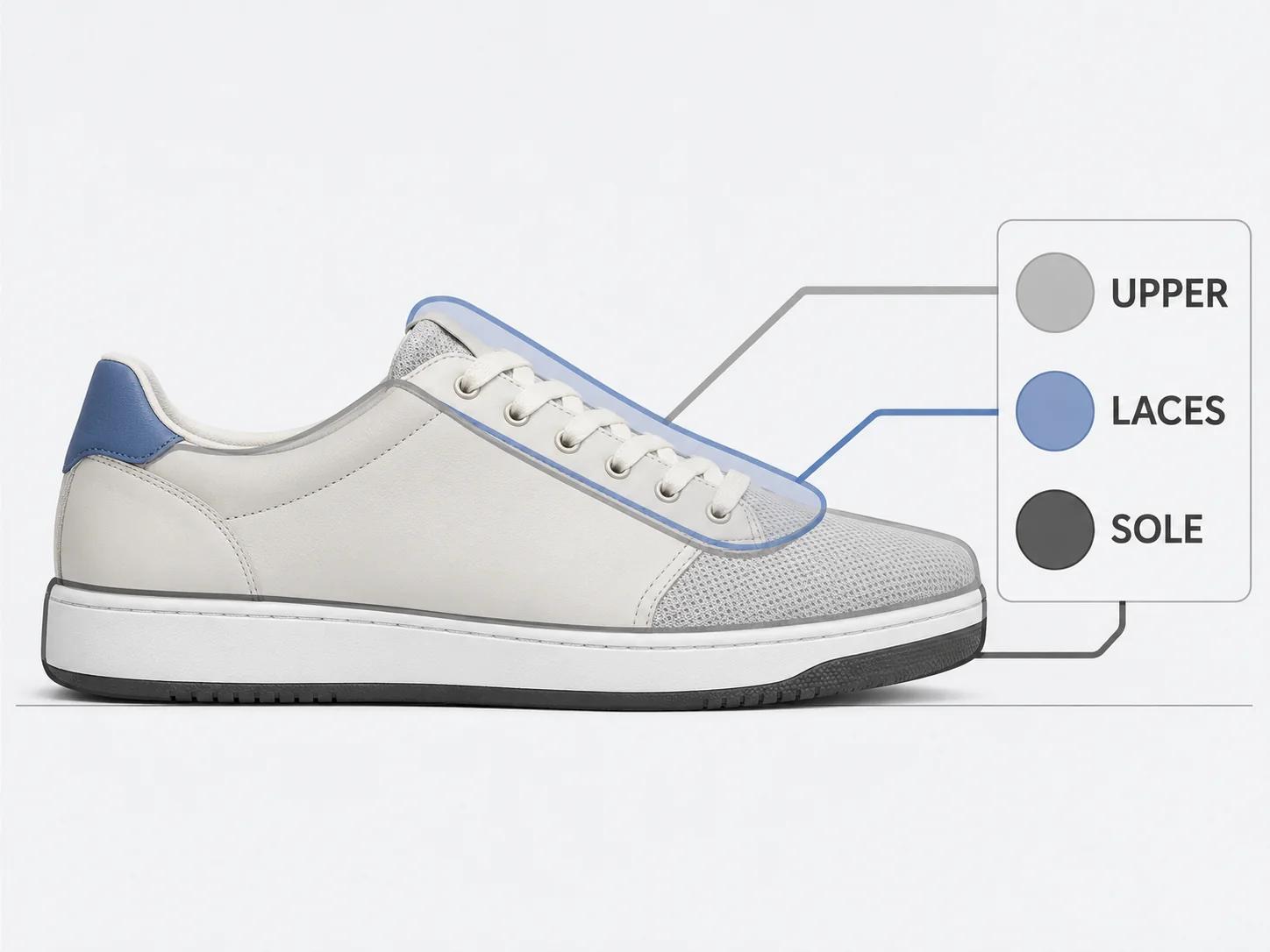
The table is a discovery tool. The actual zones depend on the approved construction and factory vocabulary. Freeze their IDs with the 3D asset and rule set. Renaming a mesh in a later export must not silently change what an existing order means.
Keep size, colorway and personalization separate
Size is not another paint swatch. The team must decide whether a size selection swaps approved geometry, selects a size family, changes only a commerce key, or triggers a separate last and sole unit downstream. Uniformly scaling one mesh is not a fit claim unless the product and manufacturing owners have approved that representation.
ISO 9407:2019 defines Mondopoint as a footwear sizing and marking method based on specified measurements of the foot the footwear is intended to fit.[3] That standard does not make a regional size label, a last, a 3D mesh and an inventory record interchangeable. Store the presented size system and the controlled internal size or fit key separately, with any conversion table owned and versioned by the merchant.
Catalog identity also needs care. GS1 states that each size, color and size-color combination is a distinct product variation requiring its own GTIN.[4] Shopify's documentation, checked on 31 August 2026, offered a platform example of the same operational split: option-value combinations could be represented as variants, with price, inventory and shipping settings managed per variant.[5] A configurator can expose more visual choices than a catalog model can hold, so define which states map to stocked variants and which become custom order attributes.
Use four separate axes:
- Base style: the construction family and compatible rule set.
- Sellable variant: a stock-bearing combination such as size plus approved colorway.
- Configurable treatment: independent panel, trim or graphic choices allowed by the rule set.
- Order personalization: text or artwork unique to one unit or pair.
This separation prevents a text change from creating a fake inventory item and prevents an unavailable size-color combination from appearing orderable merely because the renderer can display it.
Put hard boundaries around personalization
Text and graphics need production constraints before they need an editor. For text, define allowed characters, minimum and maximum length, line count, font ID and version, physical height, alignment, placement zone, decoration method and color set. For artwork, define accepted file types, dimensions, color space, transparency behavior, physical print area, bleed or safe area, orientation and review status.
Validate the same rule on the server that the browser explains. OWASP distinguishes syntactic validation from semantic validation, recommends allowlists for user-controlled fields and states that client-side validation can be bypassed.[6] A text preview may therefore reject unsupported characters immediately, while the order service repeats the length, character, placement and option-compatibility checks before accepting the configuration.
The visual preview is still useful. Show the real font where licensed, a defined fallback where it is not, and a visible safe zone at editing time. Flag a glyph that cannot be produced instead of silently substituting one. Save the raw string, normalized production string, font and process IDs, physical dimensions, transform coordinates, color code and proof image. If a human approval is required, store its status and revision rather than replacing the structured data with "see approved image."
Design cameras as inspection evidence
A shoe needs deliberate camera stops. A practical set includes lateral, medial, top, heel, three-quarter and outsole views, plus a close view of any personalized zone. Each stop should have a stable ID and target, not just a position that shifts when the model bounds change. Preserve free orbit for exploration, but make important construction and personalization areas reachable in one action.
Controls outside the canvas should carry the product state. Swatches need readable material and color names; disabled choices need an explanation; the selected option and any price change should be available without reading pixels. WCAG's Name, Role, Value criterion requires names and roles for user interface components to be programmatically determinable, user-settable states and values to be programmatically set, and changes to be available to user agents including assistive technology.[7] Use native controls where possible and expose custom swatch, camera and personalization controls with equivalent semantics.
A camera does not certify fit, color accuracy or manufacturability. It provides a repeatable review angle. Put critical color approval, material sampling, construction and size acceptance in their own process.
Connect price and availability to the rule result
The 3D scene should never calculate the commercial truth. Send the normalized selection state to a pricing and availability service. The response should return the accepted configuration, rejected or substituted choices, base price, modifiers, currency, tax treatment where applicable, stock or lead-time status, price version and expiry or revalidation rule.
Keep price modifiers tied to controlled decisions: premium upper material, special sole unit, decoration method, per-side personalization or expedited handling. Do not infer cost from the number of visible meshes. Two materials may look similar while having different minimums or processes; one visual texture may represent several supplier codes.
Define failure behavior. If price is unavailable, keep the configuration visible but block purchase with a clear recovery path. If stock changes, revalidate before cart and again before order acceptance. If an option is removed, preserve the saved state as historical evidence while explaining which current rule prevents reordering it.
Use a footwear configuration and output map
The following map is an original Double Edged decision framework. It is not a universal footwear data standard. Complete it with the merchant, product team, 3D team, commerce owner and manufacturing partner before build acceptance.
| Layer | Must resolve | System owner | Persisted output | Release gate |
|---|---|---|---|---|
| Offer | Base style, markets, size and width ranges, sellable colorways, personalization availability | Product and commerce | Offer ID, catalog IDs, market and lifecycle status | Every visible starting state can be bought or clearly marked exploratory |
| Rules | Zone options, dependencies, exclusions, defaults and fallback behavior | Product and engineering | Versioned rule set and fixtures for valid and invalid combinations | Test fixtures return the approved result without loading 3D |
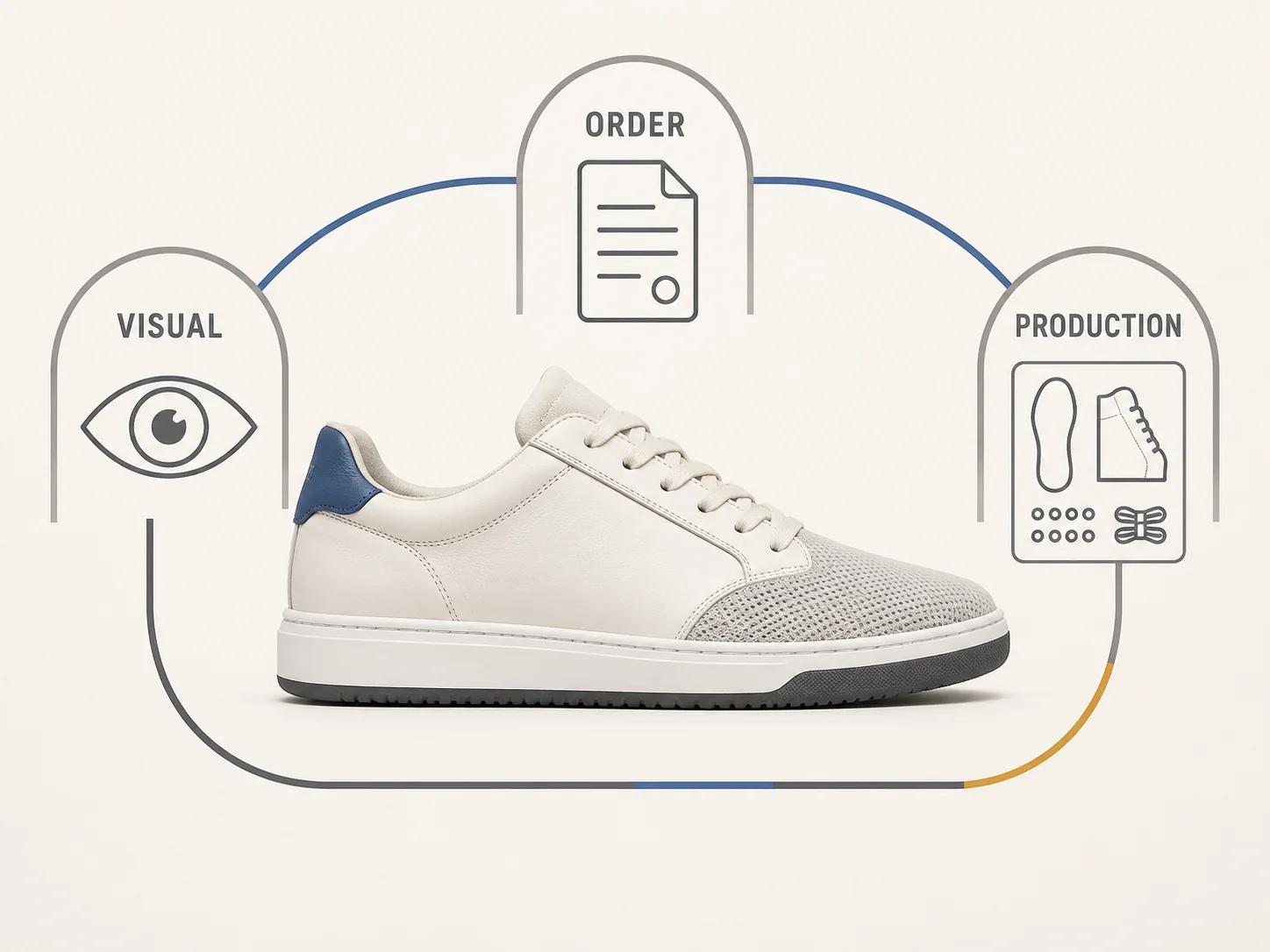
| Visual | Semantic zones, materials, graphics, visibility, cameras and asset fallbacks | 3D production | Asset version, zone map, material IDs, camera IDs and preview image | Every valid fixture renders the intended state; invalid states cannot be forced through the UI |
| Commerce | Variant, GTIN or custom-line mapping, stock, lead time, price and cart payload | Commerce and operations | Resolved item IDs, pricing response, configuration hash and cart metadata | Cart and order readback match the selected state and price version |
| Personalization | Text or art content, process, dimensions, transform, safe area and approval | Product, legal and production | Structured parameters, artwork derivative, proof and approval revision | Unsupported content or placement cannot reach production |
| Manufacturing | Panel and component codes, material-color codes, size or tooling key, decoration instructions and quantities | Manufacturing or PLM owner | BOM or component delta, operation sheet, artwork file and machine- or team-readable order data | Factory confirms the package is sufficient without interpreting the browser session |
| Audit | Rule, asset, price and output versions plus exceptions and approver | Operations and QA | Immutable order snapshot and regeneration data | A support team can reproduce what was sold and identify every later substitution |
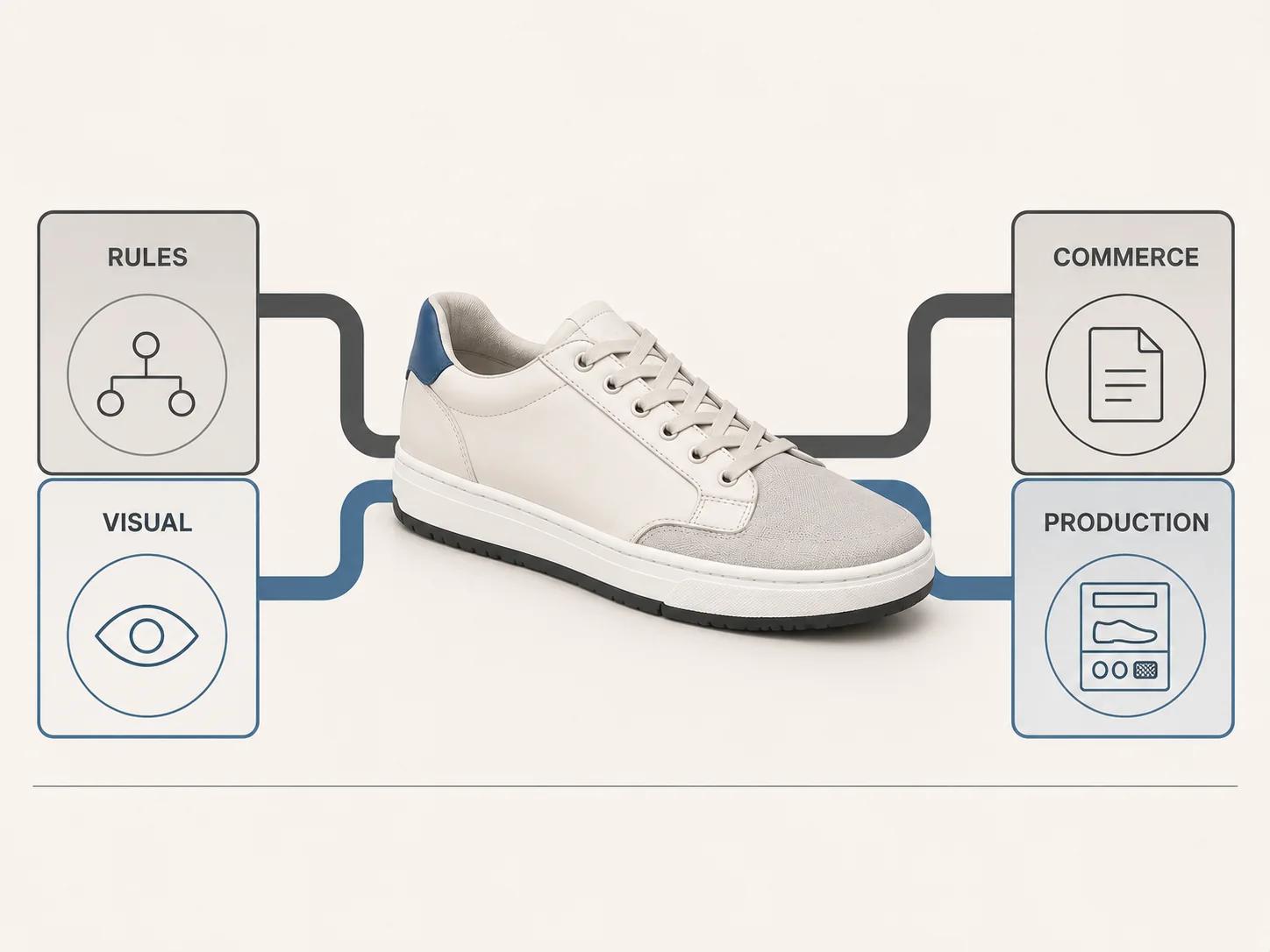
Do not promise a "production file" until its consumer is named. One factory may need a BOM delta and annotated tech-pack page. Another may accept structured JSON plus print-ready art. A made-to-order workflow may require a work-order traveler, while a stocked colorway needs only the correct variant identity. The output contract is part of discovery.
Scope the architecture and cost drivers honestly
A reusable foundation can own state management, rule evaluation, 3D loading, material switching, camera controls, price adapters, serialization, analytics events, accessibility semantics and automated test hooks. Footwear-specific discovery still owns the zones, materials, size geometry, supplier codes, decoration processes, factory output and approval chain.
| Scope driver | Lower-complexity case | Higher-complexity case | Why the scope changes |
|---|---|---|---|
| Option model | Finite approved colorways | Independent panels with conditional materials and trims | More combinations require explicit constraints and broader fixture coverage |
| Size | One visual model with certified catalog mapping | Size- or width-specific geometry, last or sole-unit logic | Asset count, review and production mapping grow |
| Personalization | Short text in one fixed zone | Per-side text, artwork, transforms and approval | Validation, art processing and review states become product features |
| Pricing | Fixed variant price plus known modifiers | Market, quantity, inventory, tax or supplier-dependent response | Pricing needs an authoritative service and revalidation policy |
| Manufacturing | Order JSON for a manually reviewed workflow | BOM delta, art derivatives, operation data and automated handoff | Output schemas, versioning and exception handling need integration work |
| Operations | One launch model and rare updates | Seasonal assortments, material retirement and saved-design reorder | Publishing, migration and support tools become ongoing scope |
The estimator should produce a complexity profile and a better discovery brief, not an invented quote. Pricing still depends on validated rules, assets, integrations, output consumers and acceptance criteria.
Separate reusable architecture from project discovery
Spellexo is relevant here only as bounded operating proof. Its case study documents Double Edged's ownership of product strategy, UX, 3D pipeline, engineering, launch and operation.[8] It publishes no measured conversion or return-rate result and does not claim configurator rescue or migration outcomes. The Spellexo case study supports the reusable product and operating perspective; it does not replace footwear discovery or prove a shoe workflow.
Build the project in that order. First, agree the configuration schema and output consumer. Next, create rule fixtures without the viewer. Then author a segmented asset against stable zone IDs, connect price and availability, generate the required production package and run end-to-end order tests. Test saved-state restoration, unavailable options, asset failure, stale price, invalid personalization, keyboard operation, reduced motion, narrow screens and recovery after a network interruption.
Acceptance should use named examples. Choose at least one stocked colorway, one made-to-order panel combination, one personalized pair, one unavailable size-color state and one rejected personalization. For each, compare the visible selection, normalized configuration, cart line, final order, price record, production output and proof image. A pass at one layer must not hide a mismatch at another.
When the rules, commerce integration or production handoff need a bespoke build, the custom 3D product configurator service is the direct project route. Bring the option map, representative shoe assets, size and pricing model, intended storefront, production recipient and acceptance examples. Those inputs make feasibility work concrete without pretending that a generic shoe model answers project-specific questions.



