

3D product configuration services should be scoped as coordinated delivery across product rules, data, UX, 3D assets, software, integrations, testing and operation. A credible proposal names who can decide each issue, what evidence unlocks the next stage and which client-side dependencies can stop the work. The calendar comes after that map.
This matters because a configurator can look complete while its commercial path remains unresolved. A model may switch finishes, yet the source of valid combinations is unclear. A polished interface may reach a staging site, yet price, cart or quote behavior is still represented by test data. A launch date built around screen progress hides those gaps.
The 3D product configurator pillar guide explains the complete category. This guide stays with delivery: the team, production workflow, dependencies, acceptance evidence and responsibility register needed to move one specific system toward release.
Define the delivery unit before assigning dates
Start by describing the product decision the configurator must support and the accepted output it must produce. Name the user, channel, representative product, configuration depth, visual behavior and downstream action. The output may be a cart line, a quote request, a saved design or a governed handoff. Do not leave it as “an interactive 3D experience.”
Then write the service boundary. A delivery package may include product-rule discovery, UX, real-time asset preparation, application engineering, commerce integration, quality assurance and launch support. It may cover only some of those areas. Either answer can work, but the excluded work needs an owner. “Client supplied” is not an owner, a due date or an acceptance standard.
The first useful requirements package should contain:
- one representative configuration journey and its final output;
- the source and owner of products, options, rules, prices and availability;
- a sample of the hardest product data and visual assets;
- the target host, connected systems and available test environments;
- supported user, market, device and accessibility needs;
- named approvers and the evidence each approver expects; and
- the intended operating owner after launch.
A team can discuss a schedule once those items are known, explicitly deferred or placed in the risk register.
Put decision rights next to the work
GOV.UK's public service manual uses a multidisciplinary delivery team and says the mix of skills should change across discovery, alpha, beta and live operation. It also includes stakeholder dependencies, user testing, security, performance and live support in the team's remit.[1] A commerce configurator is not a government service, but the underlying delivery lesson applies: design, engineering and operation cannot be treated as consecutive supplier departments that exchange a brief once.
Client-side ownership
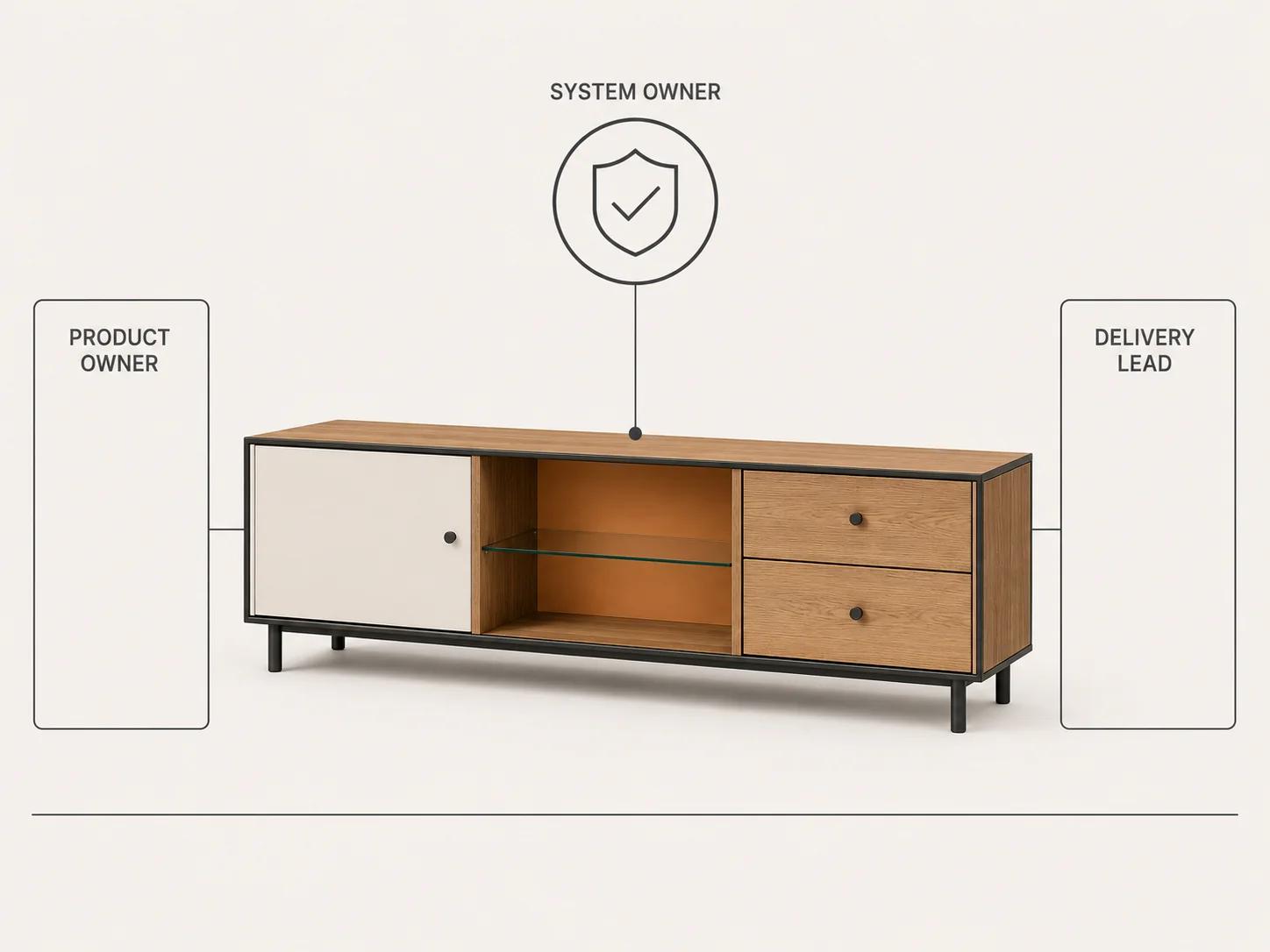
At minimum, assign four client-side decision functions. One person may hold more than one function on a focused project.
- The executive sponsor protects the outcome, budget boundary and access to other departments.
- The product owner decides which user and product problems enter the release and accepts trade-offs.
- The product-rule and data owners approve option identities, dependencies, commercial values and change behavior.
- The system owners approve interfaces, credentials, environments, release windows and operational support for commerce, PIM, ERP, CRM, CPQ or other connected systems.
A product manager should prioritize work and accept completed stories, while a service owner needs authority across delivery and operation. GOV.UK separates those responsibilities from the delivery manager's job of removing blockers and establishing the working environment.[2] The exact titles can change. The separation between product decisions, delivery coordination and technical approval should remain visible.
Delivery-side ownership
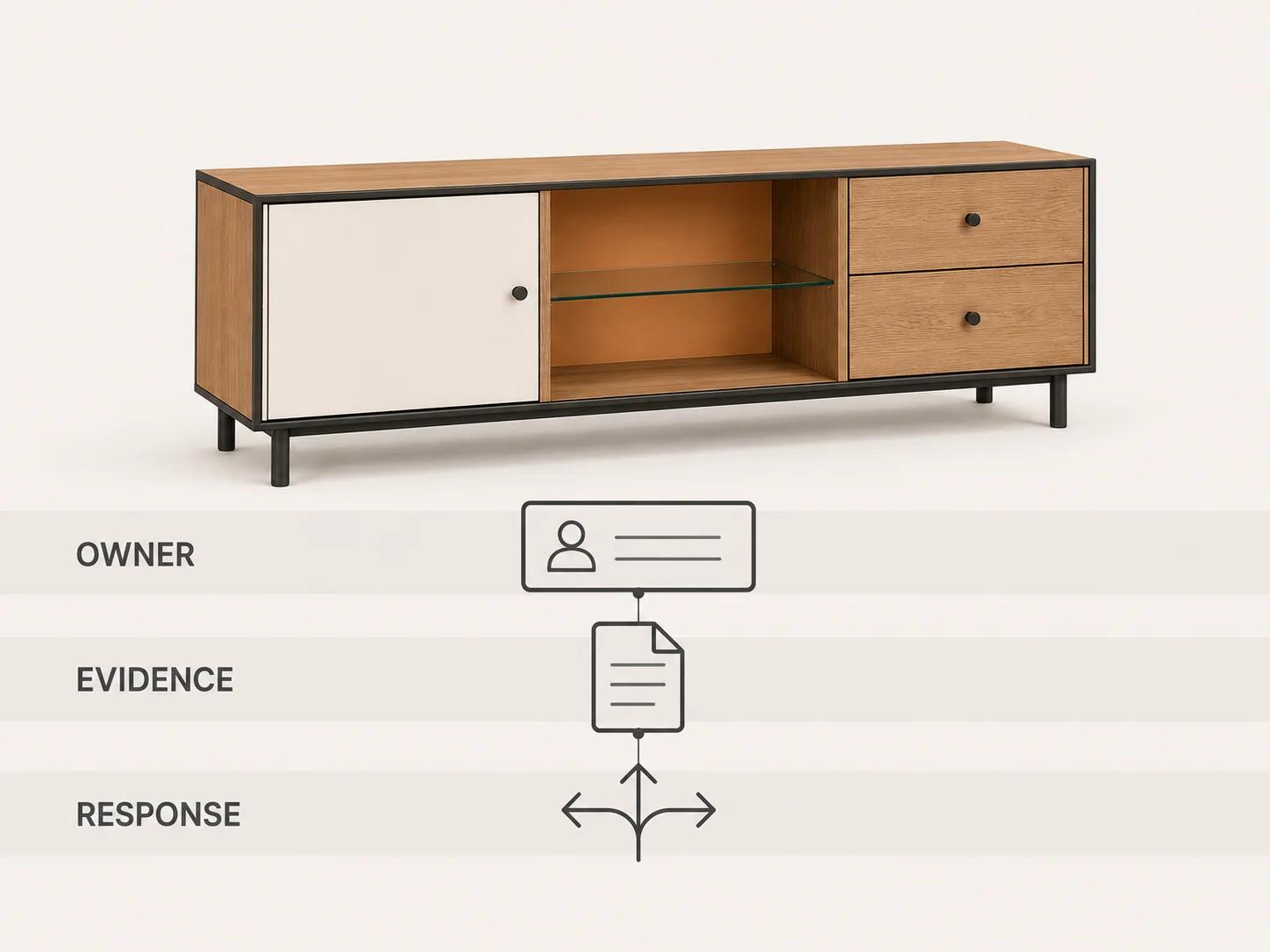
The delivery team needs an accountable lead for experience design, 3D production, product logic, application engineering, integrations and QA. Security, accessibility, analytics and operations may be dedicated roles or named responsibilities within that group. A list of people is insufficient. Every consequential decision needs one accountable owner, contributors, an approver and a recorded result.
That rule prevents two common ambiguities. The 3D artist should not silently decide which combinations are sellable, and the commerce developer should not infer product identities from labels in a scene. Both need an approved mapping from the person who owns the underlying truth.
Plan one dependency map across seven workstreams
A workable 3D product configuration services production workflow runs seven connected workstreams:
- product scope, option data and rules;
- user journeys, interface states and content;
- real-time geometry, materials, variants and visual mapping;
- application architecture and configuration state;
- pricing, save, quote, cart and enterprise integrations;
- QA across product truth, UX, devices, accessibility and security; and
- deployment, publishing, monitoring, support and catalog change.
These workstreams can overlap, but overlap does not remove their dependencies. UI production needs stable examples of valid and invalid states. Asset production needs a component and material breakdown. Integration work needs identifiers and sample contracts. QA needs supported profiles and pass criteria. Operations needs source access, release rights and an owner.
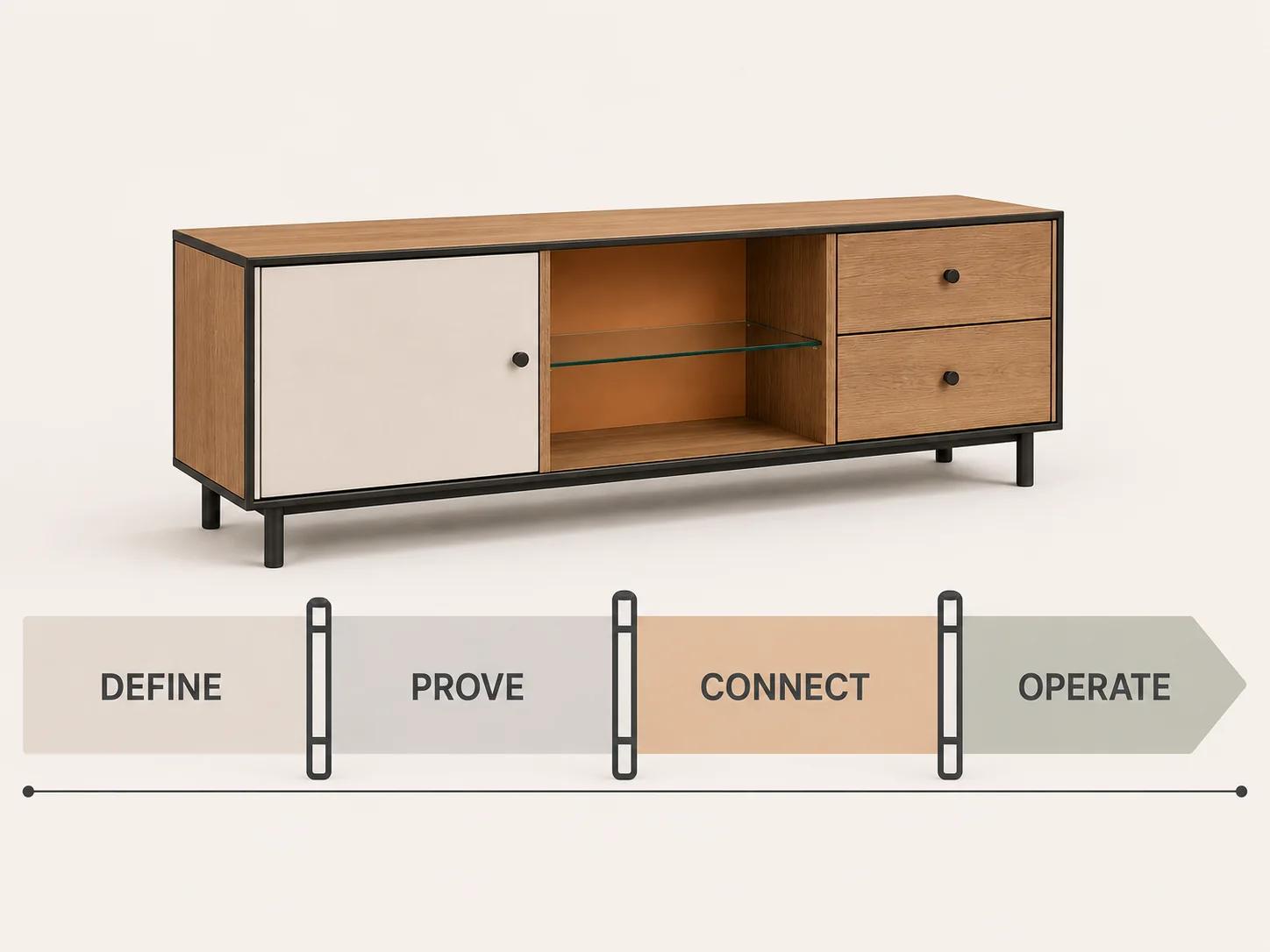
Use four evidence gates rather than treating every internal milestone as progress:
Gate 1: define
Approve the representative user path, product family, output, rule owners, system boundaries and unresolved assumptions. If the team is still deciding between a platform, custom build or hybrid model, resolve that decision with the build-versus-buy framework before expanding production.
Gate 2: prove
Build one vertical slice through the hard seams. It should use a representative product, real option identifiers, at least one dependency, target-quality visual assets and the actual downstream contract or a clearly labeled temporary substitute. The purpose is to expose feasibility and ownership issues, not to simulate catalog completion.
Gate 3: connect
Prove the selected state can cross the required integration boundary and return a result the UI can explain. Exercise rejection, stale data, timeout and retry behavior where they matter. A successful happy path is evidence for one path, not blanket approval of the integration.
Gate 4: operate
Complete acceptance evidence, release controls, documentation, access review, monitoring, rollback and the first catalog-change procedure. Launch is a transfer into an operating model, even when the same supplier remains involved.
Use one responsibility and risk register from discovery onward
A useful register ties a delivery risk to a decision owner, an observable signal and an action. Probability labels alone do not tell the team what to inspect next. Start with the rows below, replace the generic roles with names, and split any row that has two accountable owners.
| ID | Workstream and accountable owner | Dependency or failure condition | Evidence due at gate | Response while unresolved |
|---|---|---|---|---|
| R1 | Product rules — product owner | Competing rule definitions or decisions held only in people's memory | Approved examples of allowed, blocked and dependent choices at Define | Narrow the slice, record the disputed rule and block downstream acceptance |
| R2 | Catalog data — data owner | Stable IDs, values, prices or change ownership are missing | Versioned sample payload and source map at Define | Isolate assumptions; do not let UI labels become system identities |
| R3 | Real-time assets — 3D lead | Source models cannot support required parts, finishes, scale or runtime use | Representative asset audit and target-runtime proof at Prove | Test the preparation path, then revise asset scope and production forecast |
| R4 | Experience — product and UX owner | Main tasks, unavailable states or recovery behavior remain undecided | Task prototype and decision log at Prove | Resolve the workflow before polishing or multiplying screens |
| R5 | Integration — system owner | Authentication, fields, environments or failure behavior are unknown | Sample contract, sandbox response and error cases at Connect | Keep the dependency visible; a local stub cannot count as integrated delivery |
| R6 | Acceptance — QA lead and service owner | Supported profiles or pass thresholds are absent | Signed acceptance matrix before Operate | Withhold the release decision or reduce the declared support scope |
| R7 | Operations — operating owner | No owner can publish changes, monitor faults or reverse a release | Runbook, access list and rollback rehearsal at Operate | Delay handoff or reduce the release to an operable boundary |
Review this table in the working delivery meeting, not only in steering reports. Close a row when its named evidence exists and the approver has accepted it. If the response changes scope, update the schedule and acceptance plan at the same time. Keep resolved rows because they explain why the delivered boundary differs from the opening brief.
The public Custom Configurator Scope and Budget-Driver Estimator maps product rules, assets, visualization, integrations, pricing, outputs and operating ownership into a transparent complexity profile and recommended next step.[7] Use the result to organize the inputs before a delivery estimate.
Estimate the timeline after the representative proof
There is no responsible universal week count for this service. Two projects with similar interfaces can have different schedules because one has approved product data and a working sandbox while the other still needs rule discovery, asset reconstruction or security approval.
Build the first forecast from six dependency questions:
- Is the first release boundary accepted, including explicit exclusions?
- Can named owners answer rule and data questions within the review cadence?
- Has one representative asset passed the intended preparation and runtime path?
- Are integration contracts, credentials and non-production environments available?
- Have decision makers reserved time for product, visual, UX and technical review?
- Is the release window compatible with commerce freezes, security review and operational support?
For each assumption, record an owner, evidence date and schedule consequence. Separate hands-on production time from waiting time. Reforecast after the vertical slice and connected pilot because those gates replace assumptions with observed project evidence. Do not compress a blocked integration by asking the asset or interface team to work faster; that only creates more completed work waiting behind the same dependency.
Treat review availability as a real dependency. A response target is meaningless unless named approvers have reserved time and know which decision they must make. Put product, visual, security and commerce reviews on the forecast with their required inputs. If an approval is late, record which downstream tasks stop and which can continue without creating rework. This makes waiting visible without blaming a creative or engineering workstream that is already complete.
A useful schedule has ranges, gates and stated conditions. It should also show what can launch independently. One product family may be operable while a quote integration remains a later phase, provided the interim user path is accurate and accepted. That is a scope decision, not a hidden delay.
Turn the quality checklist into release evidence
A checklist is useful only when it identifies the tested object, conditions, expected result, evidence and approver. “QA complete” says none of those things.
Product and visual evidence
Test configuration examples against the approved rule source, then verify that the same resolved state appears in the interface, 3D scene, summary and downstream payload. Cover defaults, dependencies, unavailable choices, resets, save and reopen behavior, and catalog-version changes that the release claims to support.
Visual review should name the product revision, asset revision, camera, scale reference, finish source, lighting expectation and target runtime. Record accepted limitations. A desktop screenshot cannot establish mobile memory behavior, and one attractive configuration cannot prove every option mapping.
Integration and security evidence
OpenAPI 3.2.0 defines a language-agnostic description for HTTP APIs and says an OpenAPI Description formally describes an API surface and its semantics.[4] Use a versioned contract to make identifiers, requests, responses, authentication, errors and deprecation visible. Add project-specific decisions for timeouts, retries, idempotency, reconciliation and the authority of returned values.
OWASP's 2023 API risk list includes object- and function-level authorization, unrestricted resource consumption, sensitive business-flow abuse, API inventory problems and unsafe consumption of third-party APIs.[6] A configurator acceptance plan should therefore test saved-configuration access, privileged administration, pricing or quote actions, request limits, deployed versions and validation of connected-system responses. Passing those cases does not prove complete security; it provides evidence for the scoped controls.
Experience and accessibility evidence
Test the tasks users must finish, including an unavailable choice, a correction and recovery from an interrupted session. WCAG 2.2 includes testable success criteria for keyboard operation, text identification of automatically detected input errors, and labels or instructions for user input.[5] Those checks belong in the initial interaction design and acceptance cases. They are not a last-minute overlay, and passing three criteria is not a claim of full WCAG conformance.
Release evidence should retain the browser, device, viewport, network profile, assistive technology where relevant, build, product dataset and result. A failure should point back to a named owner and a register row rather than disappear into a generic bug count.
Control supplier dependency before handoff
External specialists can fill real gaps in 3D, UX, engineering or security, but the client still needs product authority and an operating owner. GOV.UK's contractor guidance recommends buying the skills that are missing, limiting supplier access to what the work requires, removing access when it is no longer needed, and planning knowledge transfer when phases or suppliers change.[3] Those are practical controls for a configurator program as well.
Put knowledge transfer into delivery work. Pair on rule modeling and publishing, keep architecture and API decisions current, record asset conventions, and rehearse a catalog update with the future operator. Inventory repositories, environments, third-party services, licenses, domains, analytics, certificates and release credentials. The handoff is weak if documentation exists but the receiving team cannot perform a safe change.
The Spellexo case study documents Double Edged's ownership of the product strategy, UX, 3D production, engineering, testing, launch and ongoing operation.[8] It publishes no measured conversion or return-rate result and does not claim rescue or migration outcomes for an existing configurator.[8] Its operating section covers publishing, asset review, browser behavior and future integration changes, which is why those responsibilities belong in the original scope.[8]
If authoritative price, quote, BOM or enterprise handoff is the dominant unresolved area, continue with the visual CPQ architecture guide rather than expanding this general delivery guide into a CPQ specification.
Check a proposal against the actual delivery risk
Before selecting a provider or approving a statement of work, ask:
- Which product, user and downstream outcome define the first release?
- Which named person owns every rule, dataset, integration and acceptance decision?
- What representative product will expose the hardest dependency first?
- Which assets and environments have been inspected rather than assumed?
- What is excluded, who owns the exclusion and when is its evidence due?
- How will valid, invalid, stale and failed states be tested?
- What evidence changes the timeline after the vertical slice?
- Who can publish, monitor, support and reverse the release?
- How will knowledge, source files, credentials and supplier access be transferred?
A proposal is ready to schedule when those answers identify people and inspectable evidence. If the remaining need is a bespoke combination of product strategy, UX, 3D production and integration, the custom 3D product configurator service is the commercial route. Use the delivery guide above to prepare the team, dependencies and evidence before starting that conversation.



